Salicylic acid is also a type of oil-soluble exfoliant. It penetrates pores and reduces excess sebum and dead skin cells, reducing inflammation that causes acne. To use it at home, use 0.5%-2% in face wash, toner, or serum. You should use it 2-3 times a day, then gradually increase the amount. Don’t forget to apply moisturizer or sunscreen.
If no matter what you try, blackheads keep coming back, or every new “anti-acne” product makes things worse before it gets better, there’s a good chance that salicylic acid is just what you’ve been looking for
It’s also something most people use incorrectly—a formula that’s too strong, too often, on skin that wasn’t prepared for it.
This guide explains what it actually does, which concentration to choose, how to incorporate it into your routine without damaging your skin barrier, and the mistakes that cause most newbies to give up on it too quickly.
What Is Salicylic Acid and How Does It Work?
Have you ever scrubbed your face really well, felt super clean, and then spotted the same blackheads sitting on your nose a week later?
That’s not your fault. That’s just how pores work.
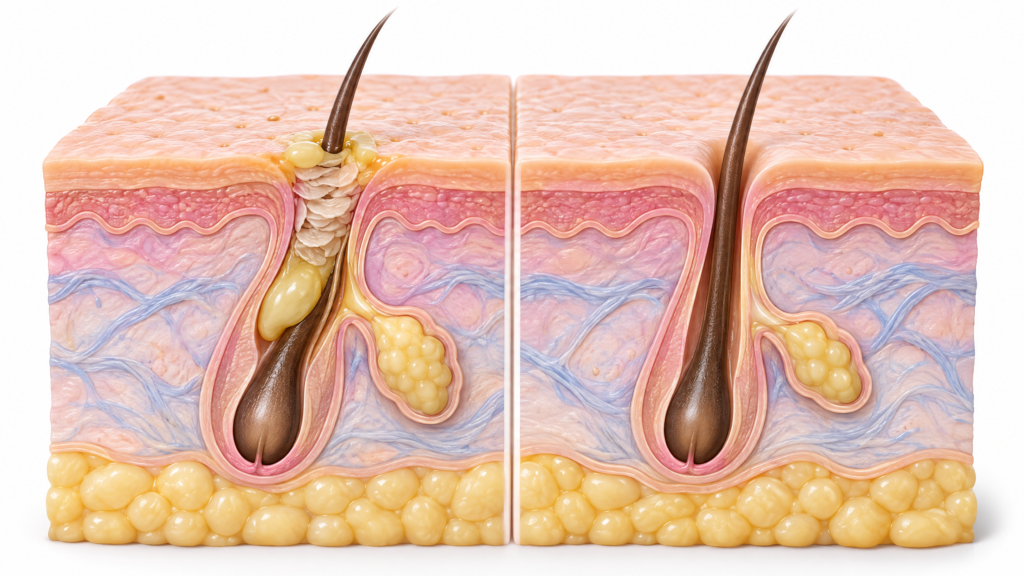
Here’s what’s happening under your skin. Your face produces oil all day. That oil is supposed to flow out through tiny openings — your pores — and keep your skin soft.
The problem starts when dead skin cells get lazy and don’t shed properly. They mix with the oil, clump together, and form a sticky plug right inside the pore.
Now, a normal face wash only reaches the top. It cleans the surface beautifully, but that plug? It’s sitting too deep. Week after week, oil keeps collecting behind it, bacteria move in, and one fine morning — a pimple announces itself.
This is exactly where salicylic acid earns its keep.
It’s an oil-loving ingredient (chemists call it a BHA — beta-hydroxy acid, originally found in willow bark).
Because it mixes so well with oil, it doesn’t stay on the surface like a scrub does. It slides down into the pore itself, loosens the stuck dead cells, and breaks the plug apart.
Picture it this way — a scrub is like sweeping your room while the drain is still blocked. Salicylic acid? It’s the drain cleaner.
Once the pore is open again, oil flows out the way it should, bacteria lose their hiding spot, and new blackheads stop forming. And here’s a bonus:
at the strengths found in regular products (0.5% to 5%), it also calms redness and swelling — so those angry red pimples settle down faster.
No rocket science. It simply goes where your problem actually lives and clears the path.
What Does Salicylic Acid Do for Your Face?
So now you know how it works. But what can you honestly expect from it? Let’s go benefit by benefit — no hype, just what’s realistic.
1. It clears blackheads and whiteheads — and stops new ones
If you only take one thing from this entire article, take this: salicylic acid is the ingredient for clogged pores. Period.
Most products fight the pimple after it shows up. Salicylic acid goes after the reason it showed up in the first place.
It dissolves the plug inside the pore, and with regular use, stops new plugs from forming.
That’s the part no face scrub can ever do — because a scrub physically cannot reach that deep.
2. It calms down active breakouts
Remember how we said it also fights inflammation? That means the red, swollen, painful pimple on your chin right now — salicylic acid can help it chill out faster.
One honest line here: it’s brilliant for mild acne — blackheads, whiteheads, and small pimples.
But if you’re dealing with deep, cystic, painful bumps that stay for weeks, no serum from a pharmacy shelf will fix that. That’s a job for a dermatologist, full stop.
3. It keeps the oil in check
If your face starts shining like a frying pan by 2 PM, you’ll love this part. With consistent use, salicylic acid helps regulate how much oil your skin pumps out, and sweeps away the oily film sitting on top.
Fair warning for the first few weeks: some dryness is normal.
That’s not the ingredient being bad — that’s it doing its job a little too enthusiastically.
Moisturizer balances it out (more on that later).
4. It smooths out bumpy texture
Those tiny closed bumps on your forehead that aren’t quite pimples but never go away?
Texture like orange peel? Regular salicylic acid use gradually clears them, because it exfoliates the lining of the pore itself, not just the surface.
Makeup sits better, skin feels smoother — usually within a month or so.
5. It fades marks left behind by old pimples
Every pimple leaves a souvenir. Salicylic acid speeds up how fast your skin renews itself, so those flat dark spots fade quicker than they would on their own.
Manage expectations though: this works for surface-level marks. Deep pigmentation or melasma needs a dermatologist’s peel (20–30% salicylic acid, done professionally) — that’s a completely different league from anything at home.
Who should use it — and who shouldn’t
Your skin will likely love it if: it’s oily, combination, acne-prone, or blackhead-prone. This is basically salicylic acid’s home crowd.
Go slow if: your skin is dry or sensitive. Start at the lowest strength, once a week, and let your skin decide the pace.
Skip it entirely if: your skin is broken, sunburned, irritated, or infected. And keep it away from your eyes and lips — always.
And here’s something worth knowing, especially for Indian readers:
dermatology research has documented salicylic acid as safe across all skin tones, including the darker Fitzpatrick types IV–VI most common in India.
Studies specifically noted minimal side effects in darker skin — so this is one ingredient where your skin color isn’t a limitation.
Which Percentage Should You Use?
Walk into any pharmacy or scroll any shopping app, and you’ll find salicylic acid in 1%, 2%, 5%, even 20%. Same ingredient, wildly different numbers. So which one do you pick?
Here’s the truth nobody puts on the label: the percentage decides what the product is for — it’s not “stronger is better.”

| Concentration | What it’s for | Where you’ll find it |
|---|
| 0.5%–2% | Acne, blackheads & oil control | Face washes, toners, serums & pads |
| 3%–6% | Thick, rough & bumpy skin | Medicated creams |
| 5%–40% | Warts, corns & calluses | Wart removers ⚠️ Never for the face |
| 20%–30% | Professional acne peels & pigmentation | Dermatologist’s clinic only |
Now let’s translate that into plain advice for your face.
For home use, live in the 0.5%–2% zone. That’s it.
Going above 2% in a leave-on product doesn’t give you faster results — it gives you a red, peeling, angry face.
And anything at 20% or higher isn’t skincare anymore, it’s a clinical procedure.
That’s the stuff dermatologists apply for 3–5 minutes under supervision and then neutralize. It has no business sitting on your bathroom shelf.
Here’s an easy way to pick between the two options inside that safe range:
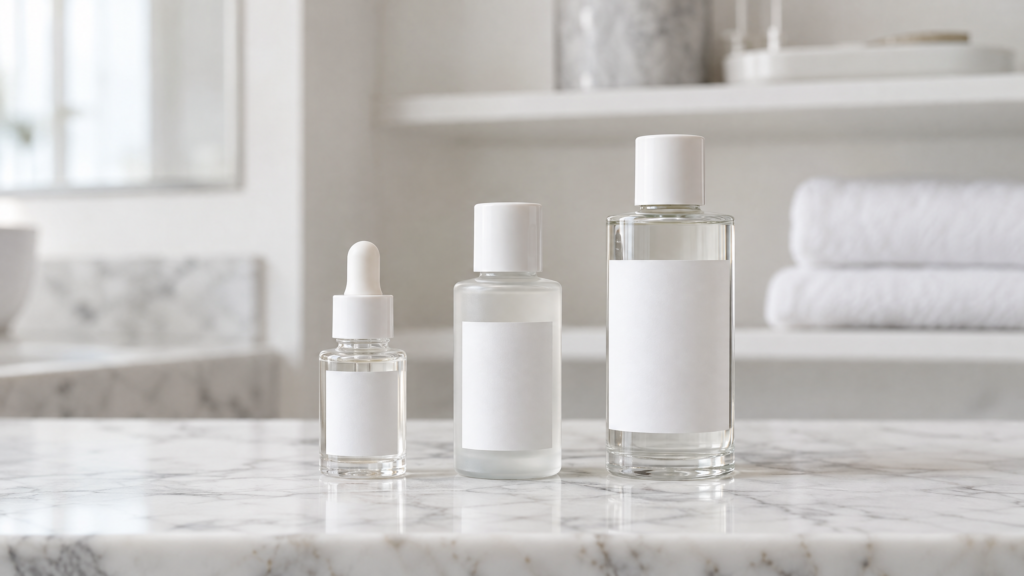
- Face wash with salicylic acid (0.5%–2%) → your gentle starter. It touches your skin for under a minute and washes off, so even daily use is usually comfortable. Perfect if you’re nervous about actives.
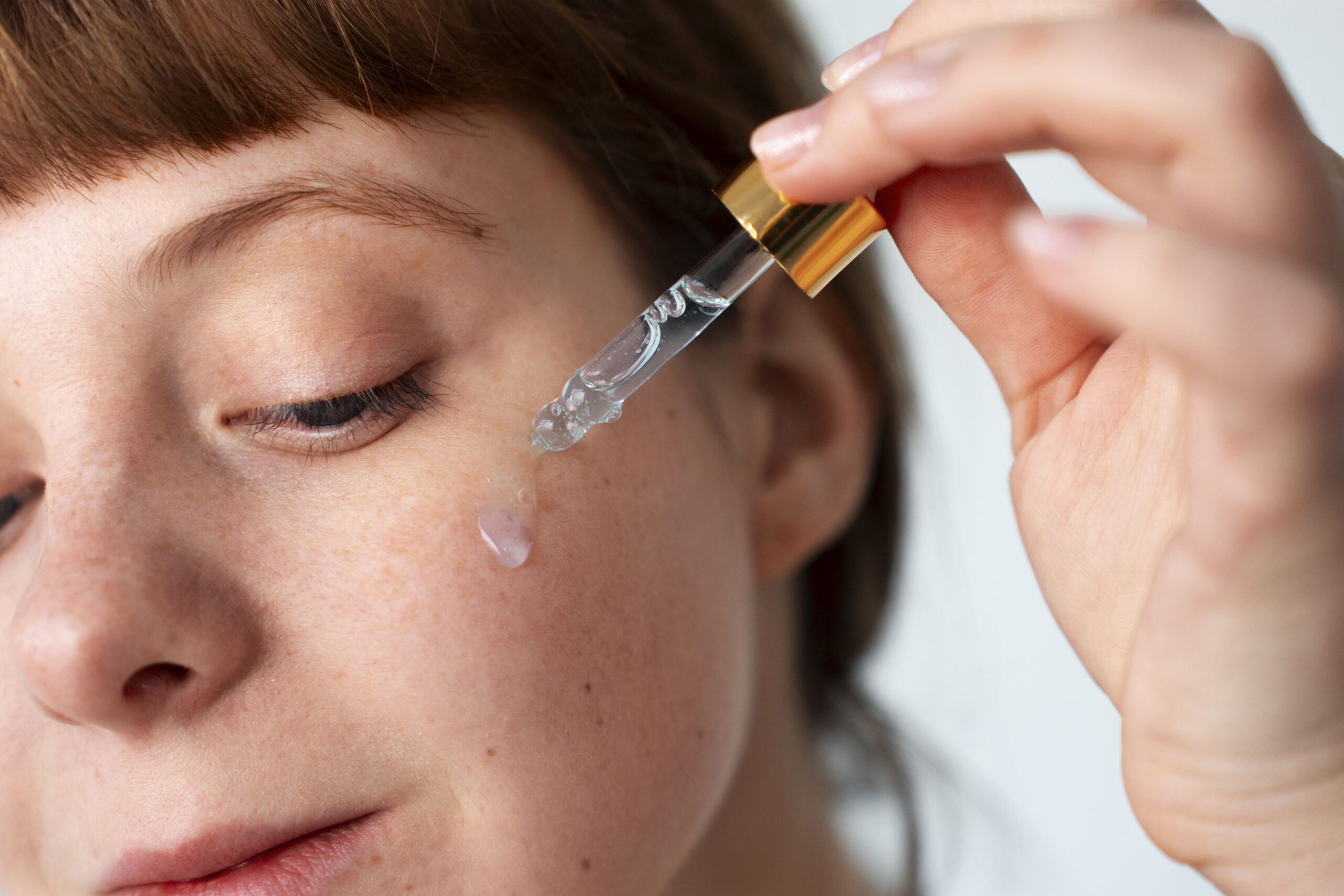
- Leave-on toner or serum (1%–2%) → the serious worker. It stays on your skin for hours, so it works harder — but it also demands respect. Start at 2–3 nights a week and let your skin set the pace.
Not sure which to buy first? The face wash. Almost always the face wash.
You can graduate to a leave-on once your skin has proven it can handle the lighter version.
How to Use Salicylic Acid on Your Face (Step by Step)
Follow these five steps in order, especially the first one — more people skip it than you’d think, and it causes half the horror stories.
Step 1: Patch test first (seriously, do this)
Before this product touches your whole face, it has to pass a small audition. Dab a little behind your ear or along your jawline — somewhere hideable — for 2 to 3 days.
What you’re checking for: mild tingling is fine, that’s the acid saying hello. Burning, visible redness, or itching?
The audition is over. That product is not for you, and you just saved your entire face from a very bad week.
Step 2: Cleanse — gently
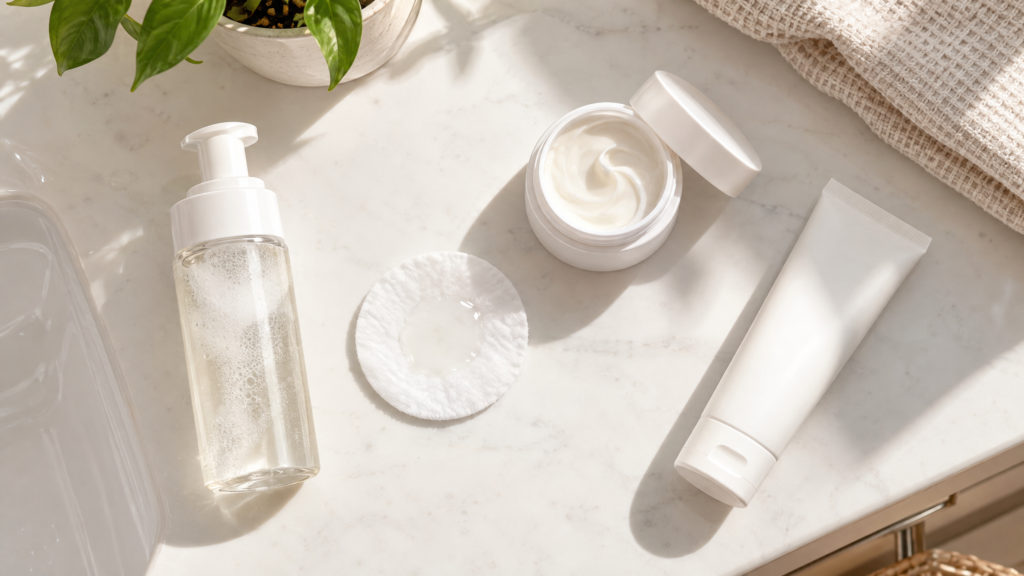
Wash your face with a mild, gentle cleanser and pat dry with a soft towel.
Don’t rub your skin into a frenzy; freshly exfoliated-adjacent skin deserves a soft hand.
And skip the gritty scrubs on salicylic acid nights — your pores are already getting exfoliated. They don’t need sandpaper too.
Step 3: Apply a thin layer
Less is genuinely more here. A thin, even layer over the areas that need it — or your full face if the formula is mild.
Steer clear of the skin around your eyes, your lips, and any cut or irritated patch.
If you’re using a strong formula, some people buffer by applying moisturizer first and the acid on top. It works a little slower but with far less drama.
Step 4: Moisturize immediately
This is the step people skip, then wonder why their skin feels like cardboard.
Salicylic acid loosens oil — that’s its job — but it doesn’t know when to stop. A good moisturizer tells it, “that’s enough.”
Apply while your skin is still slightly damp, and look for words like ceramides or hyaluronic acid on the label.
Think of moisturizer as the peace treaty between the acid and your skin barrier.
Step 5: Sunscreen, every single morning
Freshly exfoliated skin is more vulnerable to the sun. This isn’t a suggestion or a marketing line — it’s chemistry.
Finish every morning with SPF 30 or higher, even when it’s cloudy, even when you’re “just staying home near a window.” Future you, without dark spots, will be grateful.
Your starter routine (print this in your head)
| Steps | Morning | Night |
|---|
| Cleanse | Gentle face wash | Gentle face wash |
| Treat | — | Salicylic acid
(2–3 nights a week at first) |
| Moisturize | Moisturizer | Moisturizer |
| Protect | SPF 30+ | — |
That’s the whole routine. Four steps at night, three in the morning.
Any product that adds more steps than this is selling you something you probably don’t need yet.
How Often Can You Use It?
Slow. Then slower than that.
Your instinct will be to use it every night because you want results by Friday. Resist.
Salicylic acid rewards patience and punishes greed. Here’s the schedule that actually works:
- Weeks 1–2: 2–3 nights a week. Your skin is learning what this ingredient is.
- Weeks 3–4: If your skin feels normal — no stinging, no flaking — bump up to alternate nights.
- After a month: Most people land at once a night. Some of the happiest users never go past alternate nights, and honestly? That’s not settling. With actives, the minimum effective dose is the smart dose.
How to know you’re overdoing it
Your skin will tell you — you just have to listen. The two loudest complaints:
- Tight, squeaky skin after washing — like your face is two sizes too small. That’s not “deep cleaning.” That’s your barrier crying for help.
- Flaking around the nose and mouth — little skin flakes that makeup clings to.
If either shows up, don’t panic and don’t quit forever. Just pause the acid for a week, moisturize like it’s your job, and restart at a lower frequency. Your skin forgives fast when you treat it right.
Purging vs Breakouts: How to Tell the Difference
Three weeks into using salicylic acid, your skin breaks out. Cue the panic: “Is this working or ruining me?”
Take a breath. There’s a real answer to this, and once you know it, you’ll never panic-quit a good product again.
When salicylic acid speeds up your skin’s renewal cycle, it pushes everything sitting under the surface up and out —
old clogged pores, trapped oil, baby pimples that were planning to show up next month anyway.
They all arrive at once. This has a name in skincare: purging. It’s not the product failing. In a weird way, it’s the product working .
What purging actually looks like
- Pimples appear only where you normally break out — your usual T-zone, your usual chin
- Mostly small whiteheads and blackheads surfacing, not deep painful monsters
- Timing: starts around week 1–2, peaks, and then settles down within 4–6 weeks
If that pattern matches what you’re seeing, the correct move is… nothing. Keep going. It’s the awkward middle chapter before the good part.
What a bad reaction looks like
Now, the other scenario — and this one you don’t wait out:
- Breakouts in places you never break out — suddenly your cheeks, which have been clear your whole life, are a battlefield
- Deep, painful cysts, or clusters of tiny itchy red bumps
- Alongside the spots: burning, itching, or swelling that won’t quit
This isn’t purging. This is your skin saying, “I do not agree with this product.” Stop using it immediately.
No pushing through, no “maybe my skin needs to adjust.” Some products simply aren’t yours.
The one rule that settles it
Ask yourself one question: “Where are these pimples showing up?”
Old familiar spots → probably purging → wait it out. Strange new territory → reaction → stop now.
And if six honest weeks pass — purge included — and your skin is no better than where you started? Stop switching products and book a dermatologist instead.
Sometimes the answer isn’t a new serum. It’s a professional who can actually see your skin.