
Introduction (Best toners for glowing skin)
Somewhere between cleansing and moisturizing, toner became the most argued-about step in skincare. Some people swear the best toner for glowing skin is the secret to that lit-from-within look. Others — including more than a few dermatologists — call toner optional at best. Both camps have a point, and this guide is going to be honest about which is which.
Here’s what you’ll get out of this guide to the best toner for glowing skin: a clear answer to whether toner actually helps with glow, the real reasons skin looks dull in the first place, how to pick a glowing-skin toner that matches your specific skin instead of a generic “top 10” list, how to use it correctly (most people get at least one part of this wrong), and 12 genuinely good picks across Korean, Indian, and global brands. By the end, you’ll know exactly what to buy and why — not just what’s trending.

Does Toner Actually Make Your Skin Glow? (Setting Expectations Honestly)
Let’s start with the uncomfortable truth: even the best toner for glowing skin, used alone, will not give you glowing skin. No single product will. What toner can do is support the conditions that make glow possible — and that distinction matters.
A well-formulated toner does three things reasonably well:
- Rebalances your skin’s pH after cleansing, which can strip skin toward a more alkaline state depending on your cleanser.
- Adds a layer of hydration before your other products, especially if it contains humectants like glycerin or hyaluronic acid.
- Improves how well your skin absorbs what comes next — serums and moisturizers tend to sink in more evenly onto slightly damp, toned skin than onto dry skin.
What it can’t do is reverse dullness caused by things toner has no control over: chronic dehydration from not drinking enough water, sun damage built up over years, a damaged moisture barrier, or dullness that’s actually a sign of an underlying health issue. If your skin looks dull for reasons unrelated to surface hydration or pH, a toner is not going to fix it, no matter how many “brightening” claims are on the bottle.
So is toner worth it? For most skin types, yes — as a support step, not a miracle step. If your routine is otherwise solid (cleanser, moisturizer, SPF) and you’re still feeling like something’s missing, a well-chosen toner is a reasonable, low-risk addition. If your routine has bigger gaps — no SPF, no moisturizer, harsh cleansing — fix those first. Toner won’t outrun the basics.
Takeaway: Think of toner as a support step that helps your skin hold onto hydration and absorb your other products better — not a standalone fix for dullness.
What Actually Causes Dull Skin?
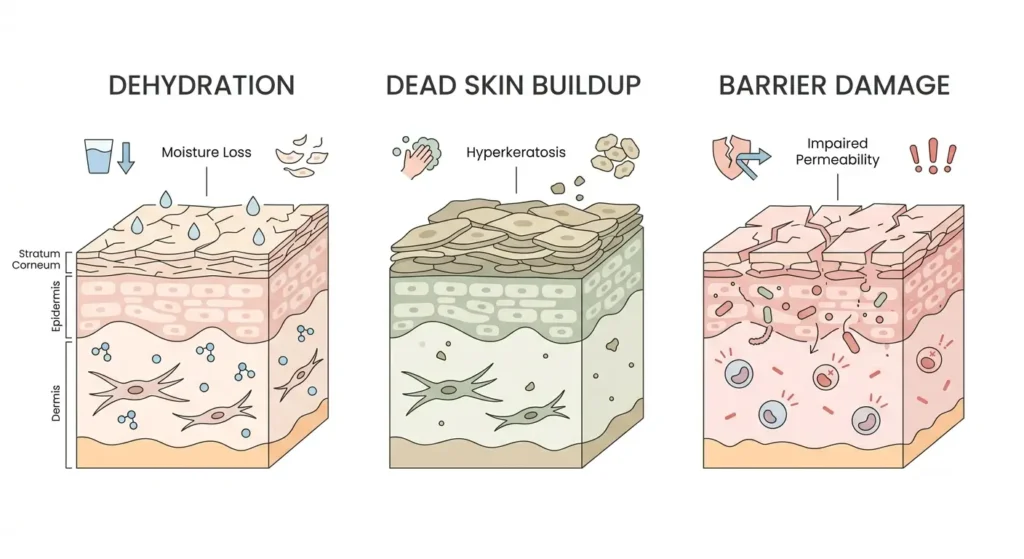
Before you buy anything, it helps to know why your skin looks dull. “Glow” products marketed at the wrong cause won’t do much.
The most common causes fall into a few buckets:
- Dead skin cell buildup. Skin naturally sheds cells, but when that process slows down (which happens more as we age, or with certain skin conditions), dead cells sit on the surface and scatter light instead of reflecting it evenly — which reads as dullness.
- Dehydration. This is different from “dry skin” (a skin type). Dehydration means your skin lacks water, regardless of your skin type — even oily skin can be dehydrated. Dehydrated skin looks flat and tired.
- Barrier damage. Over-exfoliating, harsh cleansers, or too many actives at once can compromise your skin’s protective barrier, leading to sensitivity, redness, and — yes — dullness.
- Environmental stress. Pollution, hard water, and constant shifts between air conditioning and heat (a very real issue across much of India) all take a toll on how skin looks day to day.
- Lifestyle factors. Sleep, hydration, and diet genuinely affect skin appearance, though the exact degree varies person to person and isn’t something a topical product can fully offset.
Is It Dehydration, Dead Skin Buildup, or Barrier Damage?
A quick way to narrow it down:
- Skin feels tight or flaky, looks dull → likely dehydration or dryness. Focus on hydrating, humectant-rich products.
- Skin feels smooth but looks uneven or rough in texture under makeup → likely dead skin buildup. A gentle exfoliating toner may help.
- Skin is reactive, red, or stings with products that never bothered you before, plus looks dull → possible barrier damage. Pause actives and focus on repair (this is not the moment for a strong exfoliating toner).
Getting this right matters more than picking the “best” toner on paper — the best toner is the one that matches your actual cause of dullness.
Takeaway: Identify why your skin looks dull before choosing a toner. A hydrating toner won’t fix dead-skin buildup, and an exfoliating one can make barrier damage worse.
How Toner Fits Into Your Skincare Routine
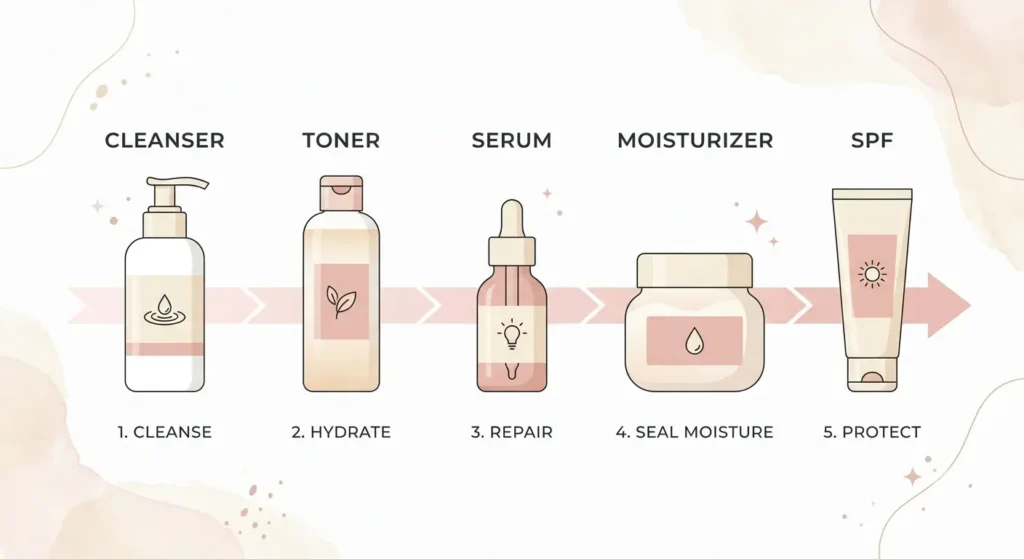
Toner goes right after cleansing and before serum — that part is simple. Where people go wrong is treating toner as a stand-in for moisturizer, or skipping moisturizer because “the toner felt hydrating enough.” Toners are typically water-based and evaporate faster than a moisturizer’s occlusive layer allows for; skipping moisturizer after toner can actually leave skin more dehydrated than before you started.
A simple, correct order looks like this:
Cleanser → Toner → (Treatment serums, if any) → Moisturizer → SPF (AM only)
Toner vs. Essence vs. Serum — What’s the Difference?
These three get confused constantly, partly because of overlapping marketing language from K-beauty-influenced brands.
| Product | Texture | Main Job | When to Use |
|---|---|---|---|
| Toner | Watery, Lightweight | Rebalances skin’s pH, provides light hydration, and prepares the skin for the next skincare steps. | Immediately after cleansing. |
| Essence | Slightly Thicker than Toner, Yet Lightweight | Delivers hydration and lightweight active ingredients deeper into the skin. | After toner and before serum. |
| Serum | Watery to Gel-Like (Depends on Formula) | Provides a high concentration of targeted active ingredients such as Vitamin C, Niacinamide, or Retinol. | After essence, or directly after toner if you’re not using an essence. |
You don’t need all three. A toner plus a well-formulated serum covers most people’s needs. Essence is a nice-to-have layering step, not a requirement.
Takeaway: Toner isn’t a moisturizer replacement, and you don’t need toner, essence, and serum — pick based on what your skin actually needs, not what a routine trend says you should own.
Ingredients to Look For (By Skin Goal)
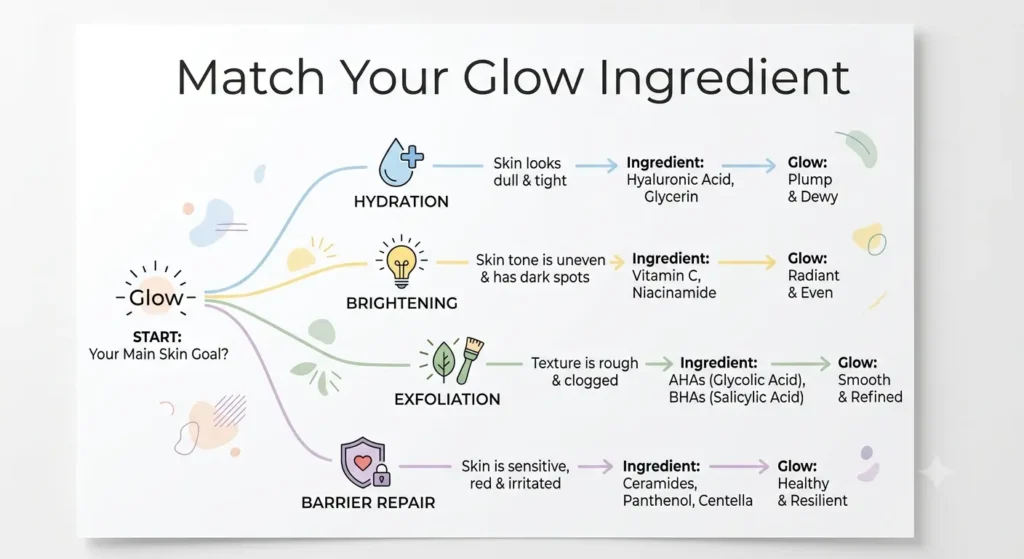
“Glow” isn’t one ingredient — it depends on what’s causing your dullness. Match the ingredient to your actual concern from the root-cause section above.
For Hydration-Based Dullness — Hyaluronic Acid, Glycerin, Panthenol
These are humectants: they pull water into the skin. Hyaluronic acid can hold significant amounts of water relative to its weight, glycerin is one of the most well-studied and reliable hydrators in skincare, and panthenol (pro-vitamin B5) hydrates while also supporting barrier repair. This combination is a safe starting point for almost any skin type.
For Uneven Tone & Brightening — Niacinamide, Vitamin C, Licorice Root
Niacinamide (vitamin B3) is well tolerated by most skin types and has research support for improving the appearance of uneven tone and strengthening the skin barrier over time. Vitamin C is a stronger brightening ingredient but is less stable and can be irritating at high concentrations, especially for sensitive skin — start with a lower percentage in a toner (rather than a leave-on serum) if you’re new to it. Licorice root extract is a gentler, plant-based option for tone-evening that’s less likely to irritate.
For Gentle Exfoliation-Based Glow — Lactic Acid, PHA, Low-% AHA/BHA
If dead skin buildup is your issue, a mild chemical exfoliant in toner form can help — but “mild” is the operative word. Lactic acid is a gentler AHA that also has some hydrating properties. PHAs (polyhydroxy acids) are the gentlest exfoliating option and a good starting point for sensitive or beginner skin. Save higher-percentage AHA/BHA toners for skin that’s already used to exfoliation.
For Soothing + Barrier Support — Centella Asiatica, Rose Water, Allantoin
If your skin is reactive or barrier-compromised, skip the actives above and focus here first. Centella asiatica (Cica) is widely used for its calming properties Cica ingredient guide. Rose water is gentle and traditional, though its actual hydrating/glow benefit is milder than actives like glycerin — it’s better suited to sensitive skin that can’t tolerate more active formulas. Allantoin is a soothing, skin-protecting ingredient often found alongside these.
Suggested visual: An infographic mapping “dullness cause → recommended ingredient” would help readers self-diagnose quickly here — worth commissioning as a simple graphic before publishing.
Takeaway: Choose your toner’s key ingredient based on why your skin looks dull, not based on which ingredient is trending.
Ingredients & Formulas to Avoid
- High concentrations of denatured alcohol (listed as “alcohol denat.” or “SD alcohol”) near the top of the ingredient list — this can be drying and irritating, especially with repeated use, and works against the hydration goal entirely.
- Added fragrance, if you have sensitive or reactive skin — fragrance is one of the most common causes of skincare irritation.
- Stacking multiple strong actives at once — for example, a toner with both a high-percentage AHA and vitamin C, used alongside a retinol serum, is a common way people accidentally damage their barrier while chasing glow.
Read more: Best Moisturizer for sensitive skin —
Takeaway: A short ingredient list with alcohol and fragrance near the top is a red flag regardless of how the product is marketed.
How to Choose the Right Toner for YOUR Skin Type
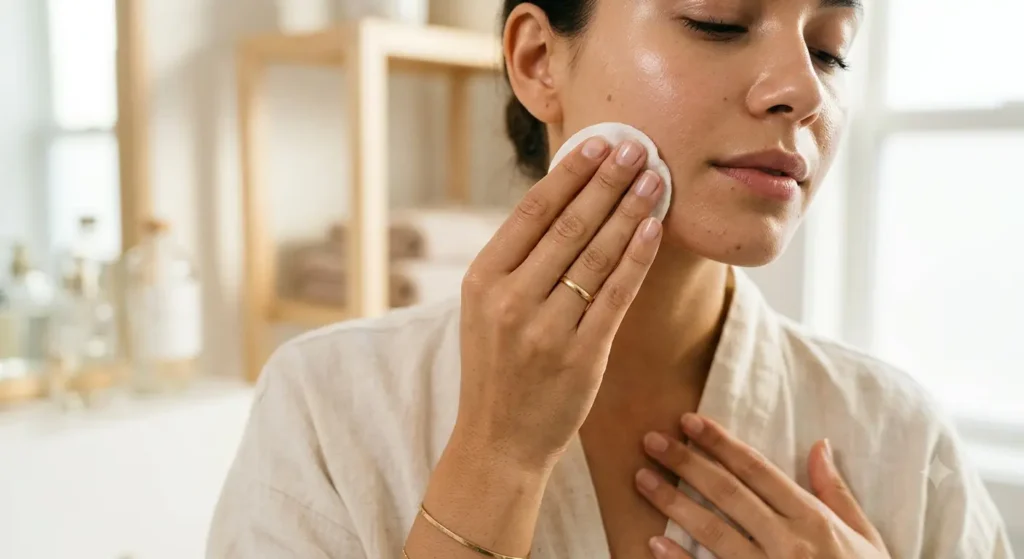
There’s no universal best toner for glowing skin — the right pick depends entirely on your skin type and what’s actually causing your dullness, which is why the table and breakdowns below are organized by skin type rather than one ranked list.
| Skin Type | Ingredient Focus | Texture to Look For | Suggested Frequency |
|---|---|---|---|
| Oily / Acne-Prone | Niacinamide, Mild BHA (Salicylic Acid), Alcohol-Free Witch Hazel | Watery, Lightweight | 1–2 Times Daily |
| Dry | Hyaluronic Acid, Glycerin, Panthenol | Slightly Richer, Milky Texture | 1–2 Times Daily |
| Combination | Balanced Humectants (Glycerin) with Light Niacinamide | Watery to Light Gel | Once Daily (Adjust by Area if Needed) |
| Sensitive | Centella Asiatica, Allantoin, Rose Water (Avoid Alcohol & Fragrance) | Watery, Minimal-Ingredient Formula | Start 3–4 Times per Week, Then Gradually Increase |
| Mature / Aging-Concerned | Hyaluronic Acid, Peptides, Gentle Antioxidants | Slightly Richer, Hydration-Focused | 1–2 Times Daily |
Oily / Acne-Prone Skin
The instinct is often to reach for a strong astringent toner to “control” oil, but stripping skin can backfire — it often triggers more oil production to compensate. A balancing, alcohol-free toner with niacinamide or a low-percentage BHA is generally a better long-term approach than a harsh, drying one.
Dry Skin
Prioritize humectant-rich formulas and skip anything with alcohol or strong exfoliants unless your skin already tolerates them well. Milky or slightly richer toner textures are fine here — the “watery = better” assumption doesn’t apply if your skin needs more hydration support.
Combination Skin
This is the trickiest to generalize. Many people with combination skin do fine with one balanced toner across the whole face; others prefer applying more product to drier areas (cheeks) and less to oilier zones (T-zone). There’s no universal rule — this is genuinely trial and error.
Sensitive Skin
Less is more. Start with a short-ingredient-list, fragrance-free, alcohol-free formula and introduce it gradually — a few times a week rather than twice daily right away — to see how skin responds.
Mature / Aging-Concerned Skin
Hydration remains the priority, since drier skin tends to show fine lines more visibly. Some toners include peptides, though the evidence for peptide effectiveness specifically in a rinse-off or leave-on toner (versus a serum, where they’re more concentrated) is less established — treat this as a nice-to-have rather than the main reason to choose a product.
Takeaway: Match texture and ingredient focus to your skin type first — the “best” toner on any list is only best if it fits your specific skin.
How to Use a Glow Toner Correctly (Most People Get This Wrong)
- Cleanse first, always — toner isn’t a cleansing step and shouldn’t be used to remove makeup or sunscreen.
- Apply while skin is still slightly damp, not fully dry — this helps with absorption.
- Pat, don’t wipe, if you’re concerned about irritation — using a cotton pad and dragging it across the skin can cause micro-friction, especially with exfoliating formulas. Clean hands work well for gentler, hydrating toners.
- Use enough product — a few drops is usually not enough to cover the full face; most people under-apply toner compared to how the product is meant to be used.
- Let it absorb for a minute before layering serum or moisturizer on top, rather than immediately piling on the next product.
Can You Use Toner With Vitamin C or Retinol on the Same Day?
Generally yes, but timing and order matter. If your toner contains an active ingredient (like an AHA or vitamin C) and you’re also using a vitamin C or retinol serum, you risk over-exfoliating or over-irritating skin by stacking too many actives in one routine. A safer approach:
- Vitamin C toner + separate retinol serum: use the vitamin C toner in the morning, retinol at night — don’t combine both in the same routine.
- Exfoliating (AHA/BHA) toner + retinol: avoid using both on the same day, especially when starting out. Alternate nights instead.
- Simple hydrating toner (no actives) + either vitamin C or retinol serum: this combination is generally low-risk, since the toner isn’t adding another active into the mix.
Takeaway: Check whether your toner itself contains an active ingredient before layering it with other actives — “just a toner” can still count as an active product if it contains AHAs or vitamin C.
The 12 Best Toners for Glowing Skin in 2026
🥇 #1: Anua Rice 70 Glow Milky Toner
Country: Korea | Best For: Overall Glow & Hydration | Price: ₹1,520 (250ml) — Nykaa
Key Ingredients: Rice water/rice bran extract, niacinamide, panthenol
Texture: Milky, slightly richer than a typical Korean toner
Why It Works: Rice water has a long history in Korean and Indian skincare traditions for brightening and softening skin; combined with niacinamide, this formula leans into gentle brightening plus hydration rather than aggressive exfoliation.
Pros: Widely liked for its comforting texture and subtle glow effect; alcohol-free.
Cons: The milky texture may feel like “too much” for very oily skin types layering multiple products.
🥈 #2: Haruharu Wonder Black Rice Hyaluronic Toner
Country: Korea | Best For: All Skin Types | Price: ₹1,304 — Amazon / Myntra
Key Ingredients: Black rice extract, hyaluronic acid, antioxidant-rich rice bran
Texture: Watery to lightly milky
Why It Works: Black rice is positioned as an antioxidant-rich ingredient in Korean skincare; paired with hyaluronic acid for hydration, this is a fairly safe, broadly tolerable pick across skin types.
Pros: Gentle formula, good beginner-friendly option for those new to Korean skincare.
Cons: As with most “all skin types” claims, those with very oily or very dry skin may still want something more targeted.
🥉 #3: COSRX Full Fit Propolis Synergy Toner
Country: Korea | Best For: Dry, Dull Skin | Price: ₹1,250 (150ml) — Tira
Key Ingredients: Propolis extract (high concentration), niacinamide
Texture: Slightly tacky/sticky on application (a known characteristic of propolis formulas), settles after a minute
Why It Works: Propolis is valued for its soothing and nourishing properties; this toner is one of COSRX’s more hydrating, glow-focused options compared to their more actives-heavy lineup.
Pros: Strong reputation for dry, dull skin specifically; noticeable plumping effect reported by users.
Cons: The tacky texture on application is polarizing — some find it off-putting even though it settles.
#4: Round Lab 1025 Dokdo Toner
Country: Korea | Best For: Sensitive Skin | Price: ₹1,199 (200ml) — Amazon
Key Ingredients: Deep-sea water (mineral-rich), simple, short ingredient list
Texture: Very watery, lightweight
Why It Works: Minimalist formulation with few potential irritants makes this a common recommendation for sensitive or reactive skin needing gentle hydration without added actives.
Pros: Fragrance-free-leaning, simple ingredient list, budget-friendly for a Korean import.
Cons: Minimal actives means minimal “glow-boosting” beyond basic hydration — better as a base-layer, gentle pick than a targeted brightening toner.
#5: Beauty of Joseon Ginseng Essence Water
Country: Korea | Best For: Brightening & Anti-Aging | Price: ₹1,240 — Amazon
Key Ingredients: Ginseng root water, niacinamide
Texture: Watery, essence-like (sits between a toner and essence)
Why It Works: Ginseng is a traditional ingredient associated with revitalizing, brightening effects in Korean skincare; combined with niacinamide, this leans into both anti-aging and glow positioning.
Pros: Popular, well-reviewed, works well as a layering step before serum.
Cons: Name is a bit misleading (it’s often used and marketed like an essence) — clarify this in your writeup so readers aren’t confused about where it fits in a routine.
#6: Minimalist PHA 3% Biotic Toner
Country: India | Best For: Oily & Textured Skin | Price: ₹360–379 — Minimalist / Purplle
Key Ingredients: PHA (gluconolactone or similar polyhydroxy acid) at 3%, prebiotic/postbiotic complex
Texture: Watery, lightweight
Why It Works: PHA is the gentlest category of chemical exfoliant, making this a reasonable entry point for people wanting mild exfoliation-based glow without the irritation risk of stronger AHAs — good match for the “dead skin buildup” cause of dullness covered earlier in this guide.
Pros: Budget-friendly, transparent ingredient labeling (a Minimalist brand strength), good for beginners to exfoliating toners.
Cons: Still an active ingredient — patch test first, and don’t stack with other exfoliants same-day.
#7: Plum Rice Water & Niacinamide Toner
Country: India | Best For: Budget Brightening | Price: ₹284–400 (150ml) — Amazon / Myntra
Key Ingredients: Rice water, niacinamide
Texture: Watery
Why It Works: A budget-accessible take on the rice water + niacinamide combination that’s trending in Korean skincare (similar concept to picks #1 and #2), making it a solid lower-cost alternative.
Pros: Widely available in India, cruelty-free positioning, accessible price point.
Cons: Less concentrated/luxurious formulation than the Korean imports on this list — manage expectations accordingly.
#8: SKIN1004 Madagascar Centella Toning Toner
Country: Korea | Best For: Acne-Prone Skin | Price: ₹540–599 — SKIN1004 India / Nykaa
Key Ingredients: Centella asiatica (Cica) extract at high concentration
Texture: Watery, lightweight
Why It Works: Centella is well-regarded for soothing irritated, acne-prone, or reactive skin Cica ingredient guide— this makes it a strong pick for readers whose dullness is tied to inflammation or barrier stress rather than pure dehydration.
Pros: Fragrance-free, simple formula, strong reputation specifically for acne-prone and sensitive-but-oily skin.
Cons: Minimal brightening actives — pairs well with a separate niacinamide or vitamin C serum if brightening is the main goal.
#9: CeraVe Hydrating Toner
Country: USA | Best For: Barrier Repair | Price: ₹1,330–1,744 — Import Stores
Key Ingredients: Ceramides, hyaluronic acid, glycerin
Texture: Slightly richer, milky
Why It Works: CeraVe’s ceramide-based approach makes this less of a “glow” toner in the brightening sense and more of a barrier-support pick — ideal for readers whose dullness comes from barrier damage (per the root-cause section above) rather than pigmentation or dead skin buildup.
Pros: Backed by a brand with strong dermatologist recommendations generally; widely available in India through authorized retailers.
Cons: Less “glow” marketing/immediate dewy effect compared to the Korean picks — the benefit here is longer-term barrier health rather than instant radiance.
#10: Isntree Hyaluronic Acid Toner Plus
Country: Korea | Best For: Deep Hydration | Price: ₹930–978 — Beauty Barn / Myntra
Key Ingredients: Multiple molecular weights of hyaluronic acid
Texture: Watery but noticeably hydrating on application
Why It Works: Using multiple weights of hyaluronic acid allows hydration at different skin depths, which is a genuine formulation advantage over a single-hyaluronic-acid product — good pick for dehydration-driven dullness specifically.
Pros: Strong hydration performance, well-reviewed for layering under other products.
Cons: Primarily a hydration play, not a brightening one — pair with a niacinamide or vitamin C serum for the “glow” half of the equation.
#11: Foxtale Multivitamin Glow Toner + Setting Spray
Country: India | Best For: Daily Glow | Price: ₹236–316 — Myntra
Key Ingredients: Niacinamide, Ethyl Ascorbic Acid (a stable vitamin C derivative), Provitamin B5 (panthenol), Betaine
Texture: Lightweight mist/spray format, alcohol-free
Why It Works: This is a dual-purpose product — usable as a toner post-cleansing or as a setting spray over makeup — combining a stable vitamin C derivative with niacinamide for a genuinely reasonable brightening approach at an accessible price.
Pros: Budget-friendly, dermatologically tested claim, versatile use case, alcohol-free formula.
Cons: Real user reviews are mixed on this one — some report it feels hydrating and non-irritating, while others report dryness or irritation after use. This is worth patch-testing carefully before full use, and worth noting honestly in your writeup rather than glossing over.
#12: Klairs Supple Preparation Unscented Toner
Country: Korea | Best For: Sensitive Skin | Price: ₹1,073–1,144 — Kindlife / Nykaa
Key Ingredients: Beta-glucan, adenosine, fatty acids for barrier support
Texture: Slightly cushiony, semi-milky
Why It Works: The unscented version removes Klairs’ original fragrance (present in the standard Supple Preparation Toner), making this the go-to choice specifically for fragrance-sensitive skin needing barrier-supportive hydration.
Pros: Long-standing reputation in the sensitive-skin community, genuinely fragrance-free (not just “unscented” marketing).
Cons: Some users find the texture slightly tacky initially, similar to the COSRX propolis pick — settles within a minute of application.
Quick Comparison Table
| Rank | Product | Country | Key Ingredients | Best For | Price (Approx.) | Best Store |
|---|---|---|---|---|---|---|
| 🥇 1 | Anua Rice 70 Glow Milky Toner (250ml) | Korea | Rice Extract, Niacinamide, Panthenol | Overall Glow & Hydration | ₹1,520 | Nykaa |
| 🥈 2 | Haruharu Wonder Black Rice Hyaluronic Toner | Korea | Black Rice, Hyaluronic Acid | All Skin Types | ₹1,304 | Amazon / Myntra |
| 🥉 3 | COSRX Full Fit Propolis Synergy Toner (150ml) | Korea | Propolis, Niacinamide | Dry, Dull Skin | ₹1,250 | Tira |
| 4 | Round Lab 1025 Dokdo Toner (200ml) | Korea | Deep-Sea Water | Sensitive Skin | ₹1,199 | Amazon |
| 5 | Beauty of Joseon Ginseng Essence Water | Korea | Ginseng, Niacinamide | Brightening & Anti-Aging | ₹1,240 | Amazon |
| 6 | Minimalist PHA 3% Biotic Toner | India | PHA 3%, Prebiotic Complex | Oily & Textured Skin | ₹360–379 | Minimalist / Purplle |
| 7 | Plum Rice Water & Niacinamide Toner (150ml) | India | Rice Water, Niacinamide | Budget Brightening | ₹284–400 | Amazon / Myntra |
| 8 | SKIN1004 Madagascar Centella Toning Toner | Korea | Centella Asiatica | Acne-Prone Skin | ₹540–599 | SKIN1004 India / Nykaa |
| 9 | CeraVe Hydrating Toner | USA | Ceramides, Hyaluronic Acid | Barrier Repair | ₹1,330–1,744 | Import Stores |
| 10 | Isntree Hyaluronic Acid Toner Plus | Korea | Multi-Weight Hyaluronic Acid | Deep Hydration | ₹930–978 | Beauty Barn / Myntra |
| 11 | Foxtale Multivitamin Glow Toner | India | Vitamin C, Niacinamide, Panthenol | Daily Glow | ₹236–316 | Myntra |
| 12 | Klairs Supple Preparation Unscented Toner | Korea | Beta-Glucan, Adenosine | Sensitive Skin | ₹1,073–1,144 | Kindlife / Nykaa |
DIY / Natural Toner Options — Do They Actually Work?
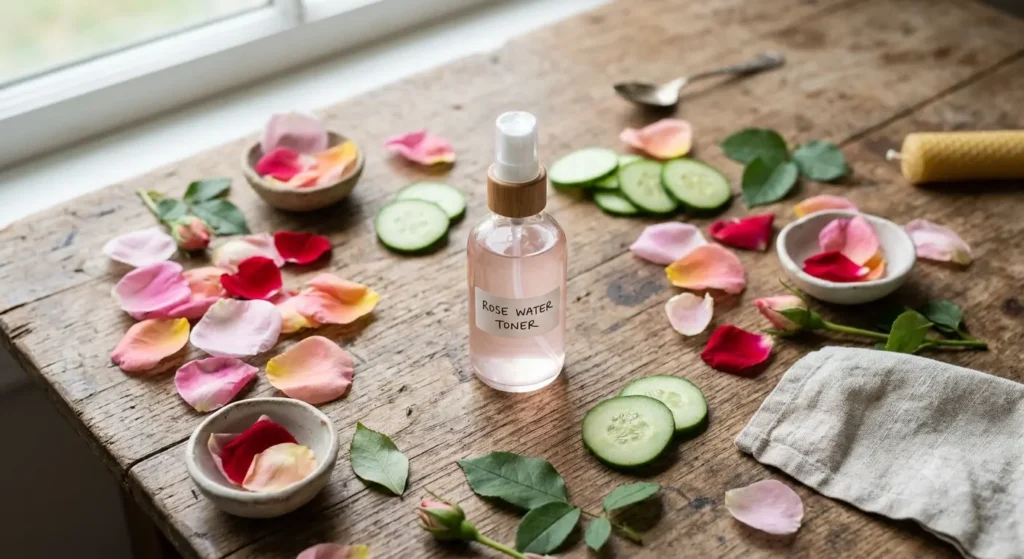
Rose water, cucumber water, and green tea are the most commonly suggested DIY toners, and they’re not without merit — they’re gentle, low-cost, and genuinely soothing for some skin types. But it’s worth being honest about their limits and risks.
What they can do: provide mild hydration and a soothing, refreshing feel. Green tea in particular contains antioxidants that may offer some protective benefit, though the concentration and stability in a homemade brew is far lower and less consistent than in a formulated product.
What they can’t do: deliver the same hydration or brightening results as a formulated toner with humectants and stable actives at researched concentrations.
The real risk — contamination. Homemade toners, especially anything involving cucumber, fruit, or plant material, lack the preservative systems that commercial products are required to have. Left at room temperature, they can develop bacterial or mold growth within days, sometimes without any visible or obvious sign. If you make your own, keep it refrigerated, make small batches, and discard after a few days rather than assuming it’s still safe to use.
Takeaway: DIY toners are a fine occasional, low-cost option for mild hydration — just don’t expect formulated-product results, and be strict about freshness and hygiene.
Common Mistakes That Sabotage Your Glow
- Over-exfoliating with multiple acid products in the same routine, which damages the barrier and causes the exact dullness and irritation you’re trying to fix.
- Skipping SPF while using brightening or exfoliating actives — these ingredients can increase sun sensitivity, and unprotected sun exposure undoes brightening efforts and causes further dullness/dark spots over time.
- Expecting overnight results — most active ingredients take weeks to show visible change, and judging a product after 2–3 days leads to unnecessary product-switching.
- Using toner as your only hydration step and skipping moisturizer, which can leave skin more dehydrated once the toner evaporates.
- Not patch testing new products, especially anything with actives — a small test area for 24–48 hours before full-face application catches most reactions early.
Takeaway: Most “glow” setbacks come from routine mistakes, not from picking the wrong product.
How Long Until You See Results?
Realistic timelines, by ingredient type:
- Hydrating ingredients (glycerin, hyaluronic acid): often noticeable within days, since the hydration effect is fairly immediate.
- Brightening/tone-evening ingredients (niacinamide, vitamin C): typically need consistent use over 4–8 weeks before visible change in tone evenness.
- Exfoliating ingredients (AHA/BHA/PHA): gradual texture improvement over several weeks; results depend heavily on consistency and not overdoing frequency.
If you’re not seeing any change after 8–10 weeks of consistent use, it may be the wrong ingredient for your specific cause of dullness — worth revisiting the root-cause section above rather than assuming the product just “doesn’t work.”
Takeaway: Give any new toner at least 4–6 weeks of consistent use before judging whether it’s working — skincare results are rarely immediate.
When a Toner Isn’t Enough (When to See a Dermatologist)
If dullness persists despite a solid routine — proper cleansing, hydration, SPF, and enough time for products to work — it may not be a skincare-product issue at all. Persistent dullness or pale, flat-looking skin combined with fatigue can sometimes be worth mentioning to a doctor rather than a skincare focus, since some causes of that appearance are unrelated to topical skincare entirely.
Persistent uneven pigmentation that doesn’t respond to consistent brightening ingredients over a couple of months is also worth a dermatologist visit — some pigmentation types (hormonal melasma, for example) need a different treatment approach than what over-the-counter toners can offer.
Takeaway: If your skin isn’t responding to a reasonable, consistent routine over 2–3 months, that’s a sign to get a professional opinion rather than keep product-hopping.
Key Takeaways
- The best toners for glowing skin is the one matched to your specific skin type and root cause of dullness — not whichever product is trending.
- Toner supports glow — hydration, pH balance, better product absorption — but it isn’t a standalone fix for dullness.
- Identify why your skin looks dull (dehydration, dead skin buildup, or barrier damage) before choosing an ingredient focus.
- Match your toner’s texture and actives to your skin type, not to what’s trending.
- Toner goes after cleansing, before serum — and never replaces moisturizer.
- Be cautious layering multiple actives (exfoliating toners, vitamin C, retinol) in the same routine.
- DIY toners are fine for mild hydration but carry real contamination risk if not made and stored carefully.
- Give any new product 4–6 weeks before judging results, and see a dermatologist if dullness or pigmentation doesn’t improve with a consistent routine.
Conclusion
Glowing skin isn’t about finding one perfect toner — it’s about understanding what your skin actually needs and building a routine around that, with the best toner for glowing skin playing a supporting role rather than the lead. Start by figuring out your real cause of dullness, pick ingredients that match it, and give your routine time to work before switching things up.
What’s been your biggest skin concern lately — dullness, dryness, or something else? Let me know in the comments, I’d love to hear what’s actually been going on with your skin.
Disclaimer
This article is for informational purposes only and is not a substitute for professional medical or dermatological advice. Skin concerns vary widely from person to person, and product ingredients that work well for one skin type may not suit another. If you have persistent skin concerns, sensitivities, or underlying conditions, please consult a licensed dermatologist before starting a new skincare routine.
Frequently Asked Questions
Ques: What is the best toner for glowing skin?
Ans: There’s no single “best” toner for everyone — the right choice depends on your skin type and what’s actually causing your dullness. Hydration-based dullness responds best to humectant-rich toners (hyaluronic acid, glycerin), while uneven tone responds better to niacinamide or vitamin C formulas.
Ques: Does toner really help skin glow?
Ans: Toner supports glow indirectly by hydrating skin, rebalancing pH after cleansing, and helping other products absorb better. It’s not a standalone solution — a full routine (cleanser, moisturizer, SPF) matters more overall.
Ques: Can I use toner every day?
Ans: Most people can use a gentle, well-formulated toner daily. If it contains strong actives like AHAs or high-percentage vitamin C, start with a few times a week and build up based on how your skin responds.
Ques: Toner vs. serum — which comes first?
Ans: Toner comes first, right after cleansing. Serum follows toner (and essence, if you use one), before moisturizer.
Ques: Is rose water toner good for glowing skin?
Ans: Rose water is gentle and soothing, especially for sensitive skin, but its hydrating and brightening effect is milder than formulated toners with humectants or active ingredients. It’s a good gentle option, not necessarily the most effective one.
Ques: Can I skip toner entirely and still get glowing skin?
Ans: Yes. Toner is a supportive step, not an essential one. A solid routine with proper cleansing, hydration, and SPF can achieve glowing skin without a toner, though toner can still add value for some skin types.
Ques: Do oily skin types need toner more than dry skin types?
Ans: Not necessarily “more” — but oily/acne-prone skin often benefits from a balancing, alcohol-free toner with niacinamide or mild BHA, while dry skin benefits more from a humectant-heavy formula. Both skin types can benefit; the ingredient focus should just differ.
Ques: Can toner cause purging?
Ans: Purging can happen with toners that contain exfoliating actives (AHAs, BHAs, retinoid-adjacent ingredients), since these increase skin cell turnover. It typically resolves within a few weeks and shows up in areas you normally break out. If it lasts longer than 4-6 weeks or appears in new areas, it’s more likely irritation than purging — stop use and reassess.
Ques: How long should I wait between toner and moisturizer?
Ans: About 30–60 seconds is usually enough for toner to absorb before applying the next step. You don’t need to wait until skin feels completely dry.
Ques: Can I use two different toners (morning and night)?
Ans: Yes — some people use a gentler, hydrating toner in the morning and a treatment toner (with an active ingredient) at night. Just avoid combining multiple strong actives across both applications without easing in gradually.
Ques: Is alcohol always bad in a toner?
Ans: Not always — some formulas use small amounts of fatty alcohols (like cetyl alcohol), which are different from drying “alcohol denat.” and are generally not irritating. The concern is specifically with high concentrations of astringent-type alcohols near the top of the ingredient list.
Ques: Why does my toner sting when I apply it?
Ans: Mild tingling with active ingredients (like a low-percentage acid) can be normal, but real stinging or burning usually signals the product is too strong for your current skin barrier health, or that you’re using it on compromised/over-exfoliated skin. Discontinue if it’s more than a very mild, brief sensation.