

(How to layer skincare products correctly) Introduction
You bought the serum everyone was talking about. You added a nice moisturizer. Maybe even a face oil. But your skin still looks the same as before.
Here’s the thing nobody tells you clearly enough: it’s not always about which products you use. It’s about the order you put them on in.
Skincare layering is simply the practice of applying your products in a sequence that lets each one actually reach your skin and do its job. Get the order wrong, and you could be wasting half of what you paid for. Get it right, and even a basic three-product routine can outperform a shelf full of expensive bottles used carelessly.
In this guide, you’ll learn the exact order to apply your skincare products, why that order matters, how morning and night routines differ, which ingredients you can safely mix, and the small mistakes that quietly ruin most routines. By the end, you won’t need to guess anymore.
Read more: Best Skincare Routine for Sensitive skin Beginners
Why the Order of Skincare Products Matters
Your skin’s outermost layer works like a gatekeeper. It lets certain things through and blocks others, depending on how thick or oily a product is.
Thin, water-based products like toners and serums can pass through this layer fairly easily. Thick products like creams and oils sit more on the surface and act as a seal. This is exactly why the order matters so much.
If you apply a rich moisturizer first and then try to use a lightweight serum on top, the serum has nowhere to go. It just sits there, on top of the cream, and eventually rubs off on your pillow or your hands. You paid for the serum, but your skin barely got any of it.
On the other hand, if you apply things from lightest to heaviest, each product gets a fair chance to sink in before the next one arrives. Nothing is blocking anything. This one shift in habit is often the difference between a routine that “does nothing” and one that visibly works.
Takeaway: The order isn’t a beauty ritual for the sake of it — it directly decides how much of your product your skin actually gets to use.
The Three Golden Rules of Skincare Layering
Before we go step-by-step, it helps to understand the three simple rules that guide almost every layering decision. Once these are clear, you’ll be able to slot in any new product correctly, even ones we haven’t specifically mentioned.
Rule 1: Apply From Thin to Thick
Always move from the lightest texture to the heaviest. Watery formulas go first, gels and lotions next, and creams or oils last. Think of it as building layers — the thinnest layer needs to touch your skin directly, so it goes closest to it.
Rule 2: Water-Based Before Oil-Based
Water and oil don’t mix. If you apply an oil-based product first, it creates a film that water-based products simply cannot get through afterward. So water-based toners, serums, and gels always come before face oils or oil-based balms.
Rule 3: Give Each Layer Time to Settle
Applying five products back-to-back within thirty seconds doesn’t give any of them a real chance to absorb. A short pause between steps — even fifteen to sixty seconds — allows each layer to settle into the skin properly instead of mixing with whatever you put on next.
Product Layering Wait Time
Product Type: Toner
Texture: Watery
Wait Time: 15–30 seconds
Product Type: Serum
Texture: Light to medium liquid
Wait Time: 30–60 seconds
Product Type: Eye Cream
Texture: Light cream
Wait Time: 30 seconds
Product Type: Moisturizer
Texture: Cream/Lotion
Wait Time: Let it absorb before makeup or SPF
Product Type: Face Oil
Texture: Oil
Wait Time: No product goes after this (except at night)
Product Type: Sunscreen
Texture: Cream/Lotion
Wait Time: 2–3 minutes before makeup
Takeaway: Thin to thick, water before oil, and patience between steps — remember just these three, and layering stops feeling complicated.
Step-by-Step Skincare Layering Order (Full Routine)
Now let’s go through the full order, step by step. Not everyone needs every step listed here — skip anything that doesn’t apply to your skin or routine.
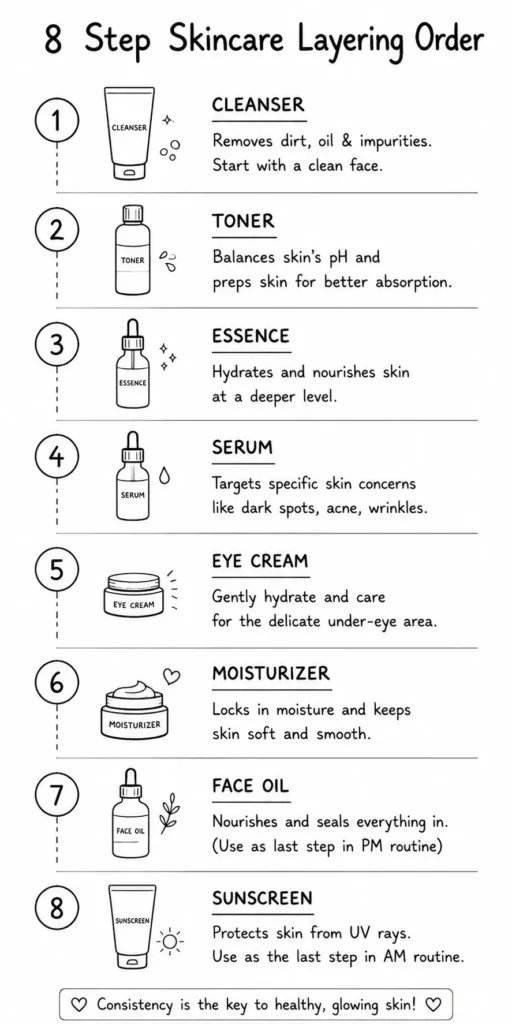
Step 1: Cleanser
Every routine starts here. A clean face means nothing is sitting on your skin blocking the next product. Use a gentle cleanser suited to your skin type — something that removes dirt and oil without leaving your skin feeling stripped or squeaky-tight.
If you wear sunscreen or makeup during the day, consider double cleansing at night: an oil-based cleanser first to break down makeup and SPF, followed by a water-based one to clean off anything left behind.
Step 2: Toner or Essence
Applied right after cleansing, a toner preps your skin and adds a light layer of hydration. This isn’t the harsh, alcohol-heavy toner from years ago — most modern toners are hydrating and gentle. It also helps the products applied after it absorb a little better.
Step 3: Spot Treatment (If You Have Active Breakouts)
If you have a pimple or an active breakout, apply your spot treatment now, directly on the area — before your serum and moisturizer. Spot treatments need to sit directly on the skin to work well, so they can’t be layered underneath other products or applied after your moisturizer.
Step 4: Serum
Serums carry a high concentration of active ingredients, whether that’s vitamin C, niacinamide, hyaluronic acid, or peptides. Apply a few drops and gently pat or press them into your face and neck.
If you’re using more than one serum, apply the thinnest, most watery one first, and the slightly thicker one after. As a general guideline, using more than two or three serums in one routine is usually unnecessary and can even reduce how well each one works.
Step 5: Eye Cream
Here’s a detail most people get wrong: eye cream goes before your moisturizer, not after.
Eye creams are made with the delicate under-eye skin in mind, which is much thinner than the rest of your face. If you apply a thicker face moisturizer first, the eye cream has to fight its way through that layer and often just doesn’t absorb properly. Applying it first, using your ring finger in a gentle patting motion, gives it direct contact with the skin.
Step 6: Moisturizer
Moisturizer comes after your treatment products and helps lock in everything you’ve applied so far. It also supports your skin barrier and prevents water loss throughout the day or overnight.
Choose a texture based on your skin type — lightweight gel-based moisturizers work well for oily skin, while richer creams suit dry or normal skin better.
Step 7: Face Oil (Optional)
If you use a face oil, it goes near the very end, after your moisturizer. Oils are heavier and are meant to seal in all the layers underneath, not deliver active ingredients themselves. This step is optional and mostly useful for dry or dehydrated skin. If you have oily or acne-prone skin, you can skip it entirely.
Step 8: Sunscreen (Morning Only)
Sunscreen is always the last step in your morning routine, no exceptions. Nothing should go on top of it, since that can dilute the protection and reduce how well it works. Apply it generously and give it two to three minutes to settle before applying makeup.
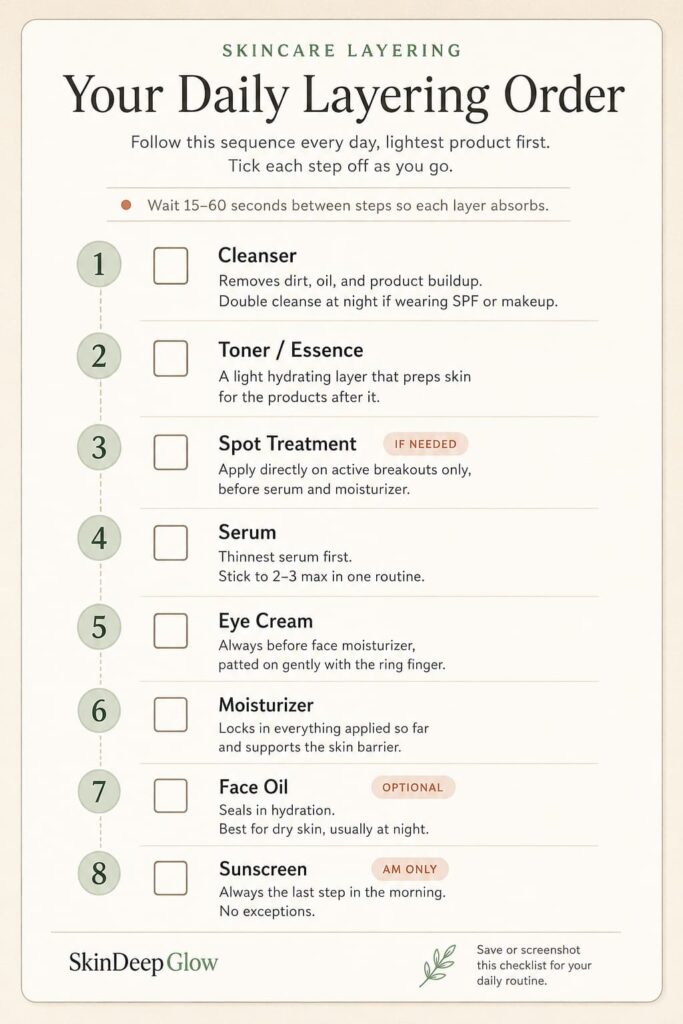
Takeaway: Cleanse, tone, treat, hydrate, seal, protect — in that order, every single time.
Morning vs Night Skincare Layering: What Changes
Your morning and night routines share the same basic structure, but the purpose behind each one is different. Mornings are about protecting your skin through the day. Nights are about letting it repair while you sleep.
| Step | Morning | Night |
|---|---|---|
| Cleanse | Light cleanse or splash of water | Double cleanse (especially if wearing makeup/SPF) |
| Toner | Hydrating toner | Hydrating toner |
| Treatment | Antioxidant serum (like vitamin C) | Retinol, exfoliating acids, or repair serums |
| Eye Cream | Lightweight, de-puffing formula | Richer, hydrating formula |
| Moisturizer | Lightweight day cream | Thicker night cream |
| Oil | Usually skipped | Optional, good for dry skin |
| Final Step | Sunscreen (always) | Skip SPF; let skin rest |
The biggest differences to remember: sunscreen belongs only in your morning routine, and heavier actives like retinol or strong acids are better saved for the night, since some of them can make your skin more sensitive to sunlight.
Takeaway: Same basic order, different priorities — protect in the morning, repair at night.
Which Skincare Ingredients Can Be Layered Together
Not every product plays well with another, even if the order is technically correct. Some active ingredients cancel each other out or cause irritation when combined. Here’s a simple breakdown.
Safe Combinations
- Hyaluronic Acid + Niacinamide — Both are gentle and hydrating, and work well applied one after another.
- Vitamin C + Vitamin E — Vitamin E can help support and stabilize vitamin C, making this a commonly recommended pairing.
- Niacinamide + Retinol — Niacinamide can help ease some of the dryness or irritation that retinol sometimes causes, though it’s still worth introducing retinol slowly.
- Peptides + Moisturizer — Peptides layer well under a moisturizer and don’t typically interact negatively with hydrating ingredients.
Combinations to Avoid
- Retinol + AHA/BHA (in the same routine) — Both increase skin cell turnover, and using them together often leads to redness, dryness, or a compromised skin barrier. Use them on alternate nights instead.
- Vitamin C + Strong AHA/BHA — Both work best at a specific, low pH level, and combining them can reduce how effective each one is, along with raising the risk of irritation.
- Benzoyl Peroxide + Retinol — These can deactivate each other when applied at the same time, reducing the benefit of both.
| Safe to Layer ✅ | Avoid Layering ❌ |
|---|---|
| Hyaluronic Acid + Niacinamide | Retinol + AHA/BHA |
| Vitamin C + Vitamin E | Vitamin C + Strong AHA/BHA |
| Niacinamide + Retinol | Benzoyl Peroxide + Retinol |
| Peptides + Moisturizer | Vitamin C + Retinol |
Takeaway: Just because two products can technically sit on your face together doesn’t mean they should. When unsure, use strong actives on alternate days instead of stacking them.
Myth vs Fact: Common Skincare Layering Beliefs
Myth: Vitamin C and niacinamide can’t be used together.
Fact: This idea comes from outdated research using unrealistic conditions. In the finished products sold today, this combination is generally considered safe and is even included together in many formulas.
Myth: More products always mean better results.
Fact: Using too many active ingredients at once increases your risk of irritation and can actually reduce how well each product performs. A focused routine of four to six products usually works better than a crowded one.
Myth: You should wait several minutes between every single step.
Fact: While some pause helps, you don’t need to time every layer with a stopwatch. A short gap of fifteen to sixty seconds is generally enough for most products.
Myth: Face oil should always go on before moisturizer since it feels lighter to some people.
Fact: Oils form a barrier that water-based products can’t pass through. Applying oil before your moisturizer blocks the moisturizer’s hydrating ingredients from absorbing properly. Oil should come after, not before.
Skincare Layering Tips by Skin Type
Oily or Acne-Prone Skin
Stick to lightweight, water-based, and gel formulas at every step. Don’t skip moisturizer just because your skin feels oily — skipping it can actually make your skin produce more oil to compensate.
Dry Skin
Focus on hydration-rich layers with ingredients like hyaluronic acid, ceramides, and glycerin. A face oil at night can help lock in extra moisture if your skin feels tight.
Combination Skin
Use lighter, oil-free products on your T-zone (forehead, nose, chin) and slightly richer products on your cheeks, where skin tends to run drier.
Sensitive Skin
Keep your routine minimal and avoid layering too many active ingredients at once. Introduce new products one at a time so you can identify what’s causing any reaction, if one occurs.
Common Skincare Layering Mistakes to Avoid
- Applying eye cream after moisturizer — This is one of the most common mistakes. Eye cream needs direct contact with the skin, so it should go on before your face moisturizer.
- Skipping the wait time between layers — Applying everything back-to-back without any gap reduces how well each product absorbs.
- Using face oil before your serum or moisturizer — This blocks everything else from being absorbed properly.
- Mixing too many strong actives on the same night — Stacking retinol, strong acids, and vitamin C together is one of the fastest ways to irritate your skin.
- Skipping sunscreen — No matter how well the rest of your routine is layered, skipping SPF undoes a lot of the benefit, especially if you’re using actives like retinol or acids at night.
- Applying makeup right after sunscreen — Give your sunscreen two to three minutes to settle before adding makeup on top.
Pros and Cons of a Multi-Step Layering Routine
| Pros | Cons |
|---|---|
| Each product gets a real chance to work | Can feel time-consuming for beginners |
| Better absorption of active ingredients | More products means more chance of ingredient conflicts |
| Easier to target multiple skin concerns at once | Higher cost if you’re buying many products |
| Helps build a stronger, more consistent skin barrier over time | Requires patience to notice results |
A multi-step routine isn’t compulsory for everyone. A simple three or four-step routine, done consistently and in the right order, is often more effective than a ten-step routine done inconsistently.
Read more: Skincare Routine for Oily Acne Prone Skin India: What Actually Worked for Me (2026)
FAQs
1. Can I use multiple serums in one routine?
Yes, but it’s best to stick to two or three at most. Apply the thinnest, most watery one first and move toward slightly thicker ones. Using too many at once can overwhelm your skin and reduce how well each one absorbs.
2. How long should I wait between skincare layers?
Generally, fifteen to sixty seconds is enough for most products to settle before applying the next one. For sunscreen specifically, wait two to three minutes before applying makeup on top.
3. Should face oil go before or after moisturizer?
Face oil always goes after moisturizer. It’s a sealing step meant to lock in everything applied before it, not deliver hydration on its own.
4. Do I really need to use eye cream separately, or can my moisturizer work under my eyes too?
If your regular moisturizer is gentle and fragrance-free, it can sometimes work for the eye area too. But most eye creams are formulated specifically for that thinner, more delicate skin, so a separate product usually gives better results.
5. What’s the minimum routine I need as a beginner?
A cleanser, a moisturizer, and sunscreen in the morning is a solid starting point. At night, a cleanser and moisturizer are enough. You can build up to serums and treatments once your skin is used to the basics.
6. Can wrong layering actually damage my skin?
It’s less about damage and more about wasted product and reduced results. That said, layering the wrong active ingredients together — like retinol with a strong acid — can genuinely irritate your skin and weaken its barrier over time.
7. When should I apply sunscreen if I’m also wearing makeup?
Sunscreen goes on after your moisturizer and before any makeup, every morning. It should always be the last skincare step, not the first makeup step.
8. Is it okay to skip toner if I don’t have one?
Yes, toner isn’t compulsory. If you skip it, just move from cleanser directly to your serum or moisturizer. You won’t be missing a critical step, though a hydrating toner can help your following products absorb a bit better.
9. Can I layer retinol and vitamin C in the same routine?
It’s generally better to keep them separate. Use vitamin C in your morning routine and retinol at night, since combining them can cause irritation and may reduce how effective each one is.
10. How do I know if I’m using too many products at once?
If your skin feels irritated, stings frequently, or you’re not sure which product is causing a reaction, that’s usually a sign you’re layering too much. Simplify your routine and reintroduce products one at a time.
Conclusion
Layering skincare correctly isn’t about following a rigid, complicated ritual — it comes down to a few simple habits: apply from thin to thick, keep water-based products before oil-based ones, give each layer a little time to settle, and always finish your morning routine with sunscreen.
Whether you’re using a simple three-step routine or a more detailed one, the order you apply your products in has a real effect on how well they work. Start with the basics, pay attention to how your skin responds, and adjust from there based on what your skin actually needs — not just what’s trending.
Read more: 10 Best Gentle Cleansers for Sensitive, Acne-Prone Skin
Note: Some ingredient-interaction claims in this article (such as specific percentages or absorption rates) should be verified against current dermatological sources before publishing, since exact figures can vary by study and formulation.
Disclaimer
This post is written to share what I’ve learned through research and personal experience — it’s not a substitute for advice from a dermatologist. Everyone’s skin reacts differently, so before trying a new product or combining active ingredients, it’s a good idea to do a patch test or check in with a skin professional, especially if you have sensitive skin or existing skin concerns.
About me
Hey, I’m Shivanshi . I write about skincare here — what’s worked for me, what hasn’t, and everything I keep learning along the way. Just trying to make skincare feel a little less confusing for you.