
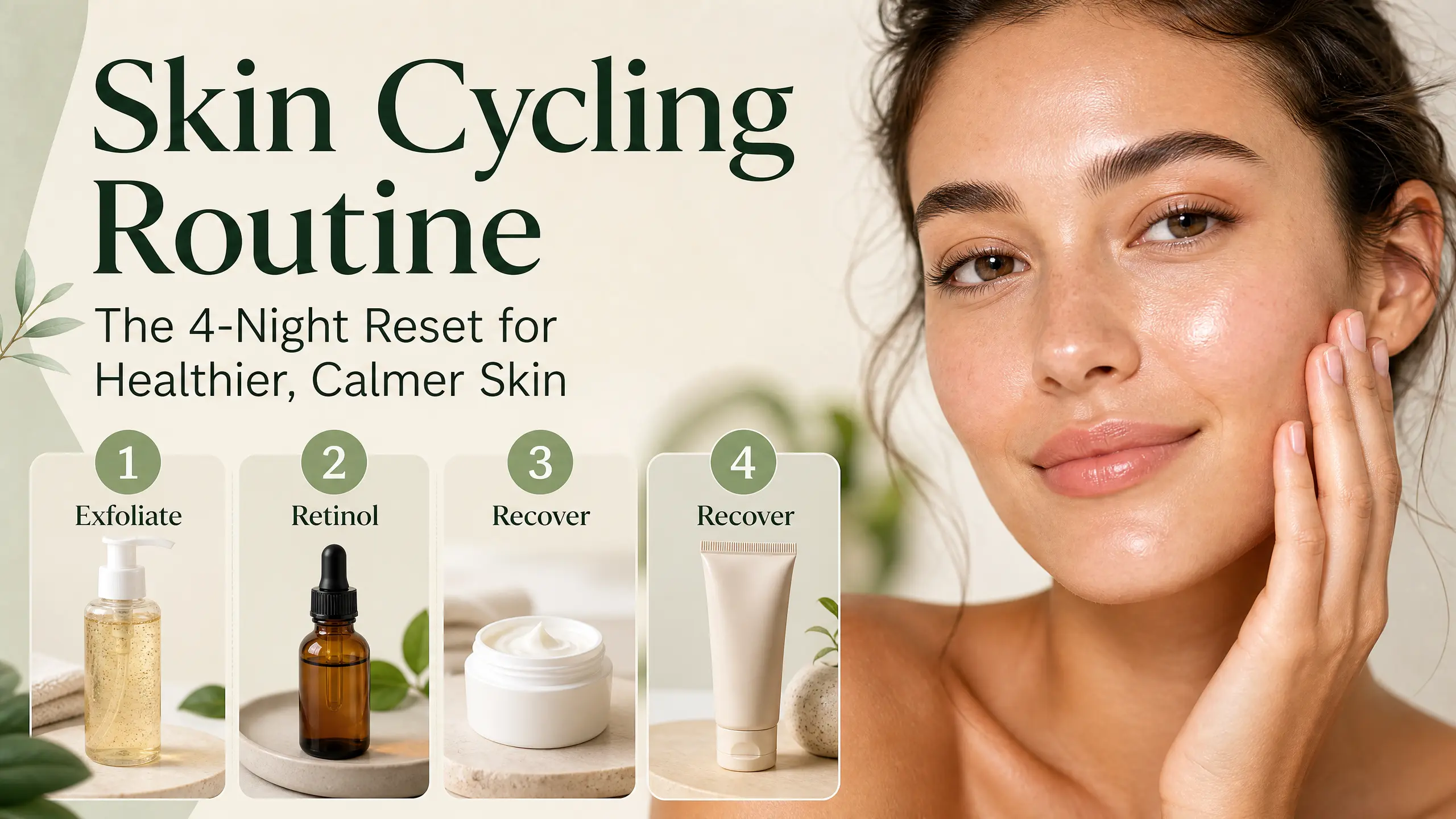
Skin cycling routine become a popular skincare method today because it offers a simple way to smartly use active ingredients. Instead of applying all products on one night, this routine staggers exfoliation, retinoid, and recovery nights, so that skin benefits are maximized and the risk of irritation is reduced.
Classic skin cycling usually lasts 4 nights: the first night for gentle exfoliation, the second night for retinoid, and the third and fourth nights for hydration and skin recovery. This can be especially useful for beginners, as it makes it easier to introduce exfoliants and retinoids correctly without overloading the skin.
But not all skin is the same. If your skin is dry, sensitive, or easily irritated, it may be better to have more recovery nights. And if you have acne, rosacea, eczema, or are using prescription treatments, it’s important to seek the guidance of a dermatologist.
In this blog, you’ll learn how skin cycling works, what to use every night, how to adjust your routine to suit your skin type, and what common mistakes to avoid.
What Is Skin Cycling?
Skin cycling is an intelligent approach to skincare that alternates active ingredients, rather than using all of them in one night. The traditional approach is to alternate exfoliant and retinoid with recovery nites focused on hydrating and moisturising.
The goal is simple: the active ingredients can help with things like clogged pores, rough texture, acne and mild pigmentation, but using them too often can make your skin dry and irritated. Planned routine allows your skin to adapt and recover between active treatments.
Skin cycling is usually described as a four-night cycle:
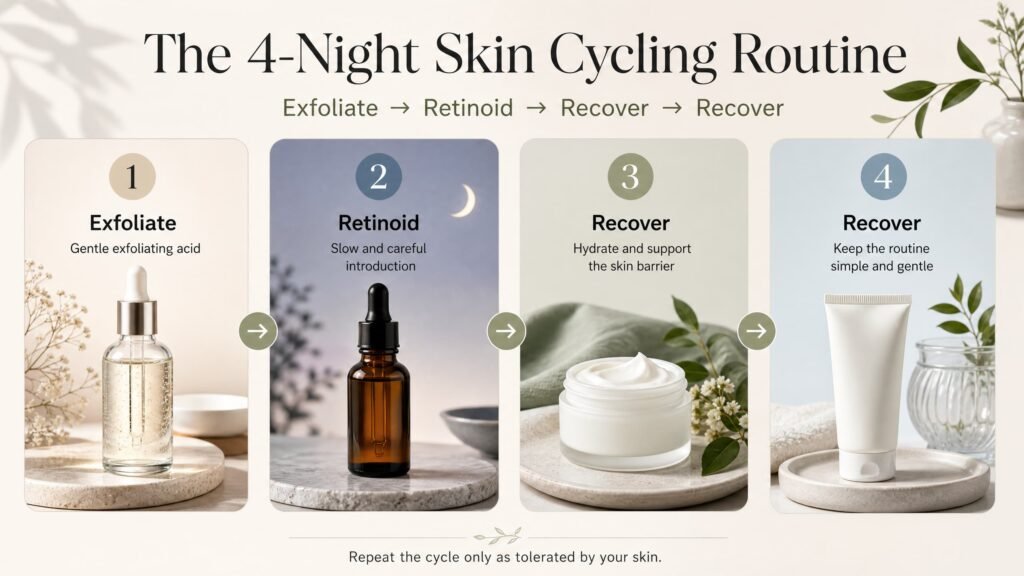
Night Main focus What it usually includes
- Night 1 Exfoliation A gentle AHA or BHA product
- Night 2 Retinoid Retinol or another suitable retinoid
- Night 3 Recovery Gentle cleanser and moisturizer
- Night 4 Recovery Hydrating and barrier-supporting products
After the fourth night, the cycle starts again. However, this schedule is not a fixed prescription. If your skin feels dry, burns, stings, or becomes unusually red, take more recovery nights and reduce the frequency of active ingredients. Those with sensitive skin or a pre-existing condition like rosacea or eczema may have to devise an individual regimen with a dermatologist.
Why Skin Cycling Is So Popular
Many people use several active products without realizing that some of them can be irritating when combined. Skin cycling makes the routine easier to understand by assigning one main purpose to each night.
It also encourages people to focus on skin-barrier care instead of believing that more products always mean better results.
The method can be a useful starting point for beginners, but it should be adjusted according to your skin’s response. The goal is not to follow the cycle perfectly. The goal is to use active ingredients carefully while keeping your skin comfortable and healthy.

What You Need Before Starting Skin Cycling
You do not need a shelf full of products. Five things are enough: a gentle cleanser, one exfoliant, a retinol, a moisturizer, and sunscreen.
Buy the cleanser, moisturizer, and sunscreen first. Add the actives later, one at a time.
Your starter kit at a glance
| Product | Use it on | Buy it now |
|---|---|---|
| Gentle cleanser | Every night | Now |
| Moisturizer | Every night | Now |
| Sunscreen | Every morning | Now |
| Exfoliant | Night 1 only | Week 2 |
| Retinol | Night 2 only | Week 4 |
1. A gentle cleanser
Your cleanser should remove oil, dirt, and sunscreen. It should not leave your skin tight. If your face feels squeaky after washing, the cleanser is too strong.
Fragrance-free is safer when you use actives.
- Dry or sensitive skin: a cream or lotion cleanser
- Oily or combination skin: a light gel cleanser
- Everyone: skip scrubs and face brushes, especially on Night 1 and Night 2
Examples: Cetaphil Gentle Skin Cleanser, CeraVe Hydrating Cleanser, La Roche-Posay Toleriane Hydrating Gentle Cleanser. Budget picks in India: Simple Refreshing Facial Wash, Minimalist Oat Cleanser.
Small tip: if your tap water is hard, your skin may feel filmy even after a good cleanser. Do a final rinse with filtered or bottled water and see if it feels different.
2. One exfoliant
Pick one chemical exfoliant. Not two. Common options are lactic acid, salicylic acid, and glycolic acid.
- Dry or sensitive skin: lactic acid, 5% is a fine start
- Oily or acne-prone skin: salicylic acid, 2%
- Uneven texture or dullness: glycolic acid, but start low at 5 to 7%
- Pigmentation-prone skin: mandelic acid is gentler and worth trying first
Start with a mild formula. Do not layer acids. Avoid strong at-home peels and physical scrubs while you are learning your skin.
Examples: The Ordinary Glycolic Acid 7% Toner, Paula’s Choice 2% BHA Liquid, Minimalist 5% Lactic Acid, Deconstruct 2% Salicylic Serum.
3. Retinol or another retinoid
Retinol is the over-the-counter version. Stronger retinoids need a prescription.
If you are new, buy the lowest strength you can find. Use a pea-sized amount for your whole face. Once a week is enough in the beginning.
Apply it to dry skin. If your skin stings, put moisturizer on first, then retinol, then moisturizer again. This is called sandwiching and it makes the first few weeks easier.
Do not use retinoids in pregnancy. If you have rosacea, eczema, ongoing redness, or very reactive skin, ask a dermatologist first. On deeper skin tones, irritation can leave dark marks that last much longer than the redness, so go slow.
Examples: The Ordinary Retinol 0.2% in Squalane, Olay Retinol 24 Night Serum, La Roche-Posay Retinol B3 Serum, Minimalist Retinol 0.3%.
4. A moisturizer
You need moisturizer on all four nights. On recovery nights it does the main work.
- Dry skin: look for ceramides, glycerin, and hyaluronic acid
- Oily or combination skin: a light gel or lotion, non-comedogenic
- Flaky or tight skin: a richer cream
In humid months, a gel-cream is usually more comfortable than a heavy cream. Keep the heavy cream for winter. You can also use two: light on the T-zone, richer on the cheeks.
Examples: CeraVe Moisturizing Cream, Neutrogena Hydro Boost Water Gel, Bioderma Atoderm Crème, Cetaphil Moisturising Lotion.
5. Sunscreen for the morning
Skin cycling happens at night. Sunscreen is what protects the results.
Use broad-spectrum SPF 30 or higher every morning. Retinoids can make skin more sun-sensitive, and sun exposure makes pigmentation worse. Wear it on cloudy and rainy days too.
- Oily skin: a matte or dry-touch formula
- Dry skin: a moisturizing formula
- Reapply if you are outdoors for long, sweating, or swimming.
Examples: La Roche-Posay Anthelios SPF 50, ISDIN Fusion Water SPF 50, Re’equil Ultra Matte Dry Touch SPF 50, Deconstruct Hybrid Sunscreen SPF 50.
What you do not need
You can skip these for now: toner, essence, vitamin C serum, eye cream, face oil, sheet masks, and any second exfoliant. Add them later if you want. None of them are part of the cycle.
How long these products last
You use the exfoliant and retinol only once every four nights. That is roughly seven or eight uses a month for each.
A 30 ml bottle usually lasts several months at that rate. So a slightly costlier active is not as expensive as it looks. Your cleanser, moisturizer, and sunscreen will finish much faster, because you use them daily.
Introduce products in this order
- Week 1: cleanser, moisturizer, sunscreen only
- Week 2: add the exfoliant, once a week
- Week 4: add retinol, once a week
- Week 6: if your skin is calm, move to the full four-night cycle
If something goes wrong, you will know exactly which product caused it.
Do a patch test first
Put a little product behind your ear or on your jawline. Do this for three nights in a row. If there is no burning, itching, or rash, you can use it on your face.
When to stop
Stop the active product if you get strong burning, swelling, deep redness, or peeling that will not settle. Go back to just cleanser and moisturizer for a week. If it does not improve, see a dermatologist.
Note: These are examples, not endorsements. Formulas change, so read the current ingredient list before you buy. Prices also change, so check before ordering.
The Classic Four-Night Skin Cycling Routine
Skin cycling follows a simple four-night pattern. The idea is to use active ingredients on the first two nights and give your skin some time to recover afterward.
Night 1: Exfoliation
Night 2: Retinol or another retinoid
Night 3: Recovery
Night 4: Recovery
After the fourth night, you can start the cycle again. But this isn’t a strict rule. Every skin type is different. If your skin is dry, sensitive, or gets irritated easily, you may need more recovery nights. [1] [3]
Night 1: Exfoliation
The first night is for gentle exfoliation. Start with a mild cleanser and pat your face dry. Apply one chemical exfoliant in a thin layer, then follow with a moisturizer.
You can choose an AHA, such as lactic acid or glycolic acid, or a BHA like salicylic acid.
Lactic acid can be a gentler choice if you’re new to exfoliation or have dry skin. Salicylic acid may work well for oily or acne-prone skin. Glycolic acid can help improve the look of uneven texture, although it may feel stronger on sensitive skin.
Keep things simple here. Use only one exfoliating product. There is no need to layer an AHA and BHA on the same night. Rough scrubs and strong at-home acid peels are also better avoided because they can irritate your skin.
If your skin tends to develop dark marks after acne, insect bites, or irritation, start with a gentle exfoliant and use it less often. Too much irritation can sometimes make pigmentation worse, especially in deeper skin tones.
Also, never exfoliate skin that is sunburned, broken, or already irritated.
Night 2: Retinoid
The second night is for retinol or another retinoid.
Cleanse your face and let it dry completely. Apply a pea-sized amount of retinol to your entire face. You do not need more product for better results.
Spread it in a thin layer, keeping it away from your eyes, lips, and the corners of your nose. Follow with moisturizer.
If retinol feels too drying, try the sandwich method. Apply a thin layer of moisturizer first, then retinol, followed by another light layer of moisturizer.
Don’t use an exfoliant on the same night as retinol. Using both together can increase dryness, peeling, and irritation.
If you’re new to retinol, start once or twice a week and see how your skin responds. You can adjust the frequency later if your skin is comfortable with it.
Prescription retinoids, such as tretinoin, are different from over-the-counter retinol. If you’re using a prescription retinoid, follow your dermatologist’s instructions instead of copying a standard skin-cycling routine.
Retinoids should be avoided during pregnancy. If you have rosacea, eczema, persistent redness, or very sensitive skin, talk to a dermatologist before using them.
Nights 3 and 4: Recovery
Now comes the easiest part: do less.
Skip active ingredients on both recovery nights. Gently cleanse your face and apply a fragrance-free moisturizer that suits your skin type.
Ingredients such as ceramides, glycerin, and hyaluronic acid can help keep the skin hydrated and support the skin barrier.
If your skin feels sensitive, avoid acids, retinol, harsh scrubs, and strongly fragranced products.
Recovery nights may feel like you’re not doing much. That’s actually the point. They give your skin some time to settle down before you use active ingredients again.
The Cycle at a Glance
| Night | Routine | Main Purpose |
|---|---|---|
| Night 1 | Exfoliant + moisturizer | Improve the look of dullness and uneven texture |
| Night 2 | Retinol + moisturizer | Support skin renewal and smoother-looking texture |
| Night 3 | Gentle cleanser + moisturizer | Hydrate and calm the skin |
| Night 4 | Gentle cleanser + moisturizer | Support the skin barrier |
Sunscreen Every Morning
Skin cycling doesn’t end when you wake up.
Apply sunscreen every morning, including the mornings after recovery nights. Choose a broad-spectrum sunscreen with SPF 30 or higher.
Sun exposure can make pigmentation and uneven skin tone more noticeable. If you’re sweating, swimming, or spending a long time outdoors, remember to reapply.
When to Change the Pattern
The four-night cycle is a starting point, not something you have to follow perfectly.
Dry or sensitive skin may need three or more recovery nights before using another active. Even oily skin can become irritated if active products are used too often.
You can also take extra recovery days during cold, dry weather or whenever your skin starts feeling uncomfortable.
The goal isn’t to fit as many active nights into your week as possible. It’s to find a routine your skin can handle consistently without damaging its skin barrier.
When to Stop
Pay attention to how your skin reacts.
If you experience swelling, painful peeling, raw patches, spreading redness, or burning that doesn’t settle quickly, stop using the active products.
Go back to a simple routine with a gentle cleanser and moisturizer. If the irritation doesn’t improve, speak with a dermatologist.
If you have eczema, rosacea, psoriasis, active inflammatory acne, or another diagnosed skin condition, it’s better to get professional advice before starting skin cycling.

How to Adapt Skin Cycling to Your Skin Type
The classic four-night routine is easy to remember, but your skin may not respond to it in the same way as someone else’s. Skin type, weather, age, and the strength of your products can all change how much recovery time you need.
Instead of forcing your skin to follow a fixed schedule, use the four-night routine as a starting point. Then adjust it according to how your skin feels and looks.
Skin Cycling for Dry or Sensitive Skin
Dry or sensitive skin usually needs a slower approach. Start with one exfoliation night and one retinoid night, followed by three or four recovery nights. You do not need to repeat the cycle every four days.
Choose a gentle cleanser and a fragrance-free moisturizer. Lactic acid may feel more comfortable than a strong glycolic acid product, but even a gentle exfoliant can cause irritation if used too often. Begin with a low-strength formula and use a small amount.
If retinol makes your skin feel tight or flaky, use the sandwich method. Apply moisturizer first, then retinol, followed by another thin layer of moisturizer. Stop if the dryness becomes painful or your skin begins to crack.
Skin Cycling for Oily or Acne-Prone Skin
Oily skin may tolerate active ingredients better, but that does not make it immune to irritation. Over-exfoliating can still damage the skin barrier and may worsen breakouts.
Salicylic acid may be a suitable exfoliant for oily or acne-prone skin because it helps remove excess oil from the pores. Use a lightweight, non-comedogenic moisturizer even if your skin feels oily. Skipping moisturizer can leave the skin feeling dry and may encourage you to use more harsh products.
If you have painful, widespread, or cystic acne, do not rely on a standard skin-cycling routine alone. A dermatologist can recommend a treatment plan that suits your condition.
Skin Cycling for Combination Skin
Combination skin can be difficult to manage because some areas feel oily while others feel dry. You do not have to apply the same amount of product everywhere.
Use a lightweight moisturizer on oily areas and a richer layer on dry areas. If needed, apply salicylic acid only where you experience clogged pores. Avoid applying strong exfoliants repeatedly to dry cheeks or other sensitive areas.
Retinol should usually be applied in a thin layer across the face rather than used only on individual spots. Follow the product directions and protect the delicate areas around your eyes and lips.
Skin Cycling for Mature Skin
Mature skin may become drier and more sensitive over time. Start with fewer active nights and give your skin longer recovery periods. A gentle cleanser, moisturizer, and daily sunscreen should remain the foundation of the routine.
Retinol may support the appearance of fine lines, uneven texture, and mild pigmentation, but results take time. Using a stronger product more often will not necessarily make results appear faster. It may only increase irritation.
| Skin Type | Starting Schedule | Product Approach |
|---|---|---|
| Dry or Sensitive | 1 active night + 3–4 recovery nights | Mild exfoliant, low-strength retinol, rich moisturizer |
| Oily or Acne-Prone | Classic 4-night cycle, if tolerated | Salicylic acid, suitable retinol, lightweight moisturizer |
| Combination | Classic cycle with area-specific hydration | Use products according to the needs of each area |
| Mature or Easily Irritated | 1 active night + 3 or more recovery nights | Gentle products and longer recovery time |
Let Your Skin Set the Pace
Some signs mean your routine needs to slow down. These include persistent dryness, burning, unusual redness, painful peeling, or increased sensitivity to products that normally feel comfortable.
When this happens, stop the active ingredients and return to gentle cleansing, moisturizer, and sunscreen. Restart only when your skin feels calm again. If the irritation keeps returning, speak with a dermatologist before continuing.
Skin cycling works best when it is flexible. The right routine is not the one with the most active ingredients. It is the one you can follow consistently without making your skin uncomfortable.
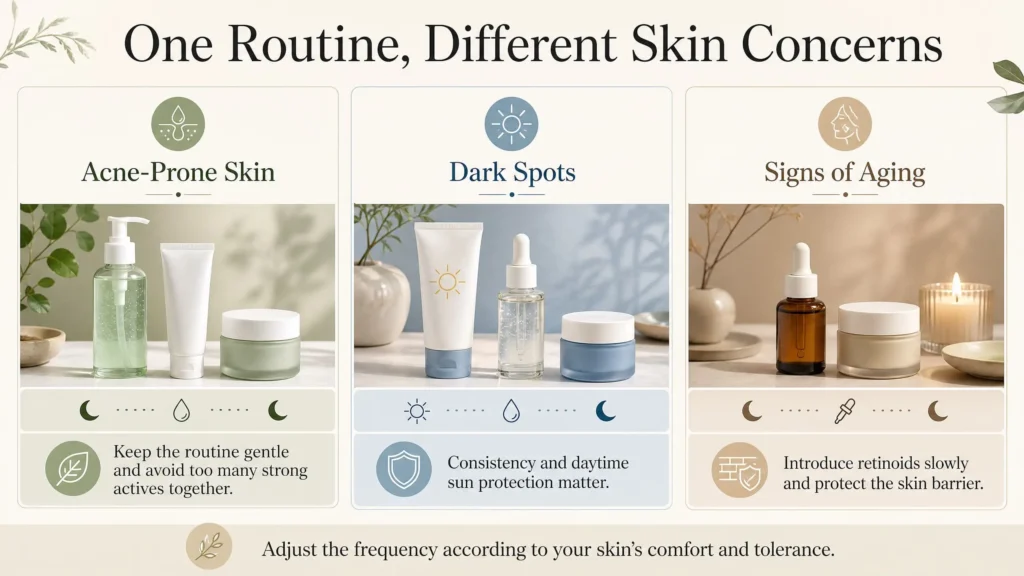
Skin Cycling for Specific Skin Concerns
Skin cycling can help organize your routine, but it is not a cure for every skin problem. The products you choose and the number of recovery nights you need should depend on your main concern and your skin’s response.
Skin Cycling for Acne
If clogged pores or mild breakouts are your main concern, salicylic acid may be a suitable choice for exfoliation night. It can help remove excess oil and buildup from the pores.
Retinol may also help improve the appearance of acne-prone skin over time. Start slowly, especially if you already use acne treatments. Using several active products together can lead to dryness and irritation.
Oily skin still needs moisturizer. Choose a lightweight, non-comedogenic formula. Avoid picking or squeezing breakouts, as irritation and skin injury can leave dark marks or scars that take longer to fade.
If you have painful cysts, widespread acne, or breakouts that are leaving scars, speak with a dermatologist. You may need a treatment plan that goes beyond a standard skin-cycling routine.
Skin Cycling for Dark Spots and Uneven Skin Tone
Sun exposure, acne marks, and skin irritation can make pigmentation more noticeable. A gentle routine may improve the appearance of uneven skin tone, but results take time.
Daily sunscreen is essential. Without sun protection, UV exposure can darken existing marks and contribute to new pigmentation. Choose a broad-spectrum sunscreen with SPF 30 or higher, and reapply when needed.
Avoid aggressive exfoliation. If your skin tends to develop dark marks after acne, insect bites, or irritation, start with a mild exfoliant and add more recovery nights. Irritation itself can trigger post-inflammatory hyperpigmentation, particularly in deeper skin tones.
Retinol may support a more even-looking complexion, but introduce it gradually. Stop using it if you notice painful flaking, burning, or unusual redness.
Skin Cycling for Uneven Texture and Fine Lines
Retinoids are often used to improve the appearance of fine lines and uneven texture. An exfoliant may also help remove dead surface cells and leave the skin feeling smoother.
You do not need to use both products more often to see results sooner. Start with the classic schedule, or add extra recovery nights if your skin needs them. A routine you can follow consistently is more helpful than an aggressive routine that causes irritation.
Moisturizer is especially important if retinol or acids leave your skin feeling dry. Apply sunscreen every morning to protect your skin from UV exposure and help prevent uneven tone from becoming more noticeable.
When Skin Cycling Is Not the Right Choice
A standard skin-cycling routine may not be suitable if you have eczema, rosacea, psoriasis, severe acne, or active skin irritation. It may also need to be modified if you are already using prescription treatments.
Pregnant people should avoid retinoids unless their healthcare professional gives different advice. If you use prescription tretinoin or another strong retinoid, follow your dermatologist’s instructions instead of adding extra exfoliation.
Do not begin skin cycling on sunburned, broken, or inflamed skin. Start with gentle cleansing, moisturizer, and sun protection. If the problem continues or becomes worse, seek professional advice.
The best routine is one that suits your skin’s needs. Skin cycling should make your routine easier to manage, not create another reason for irritation.
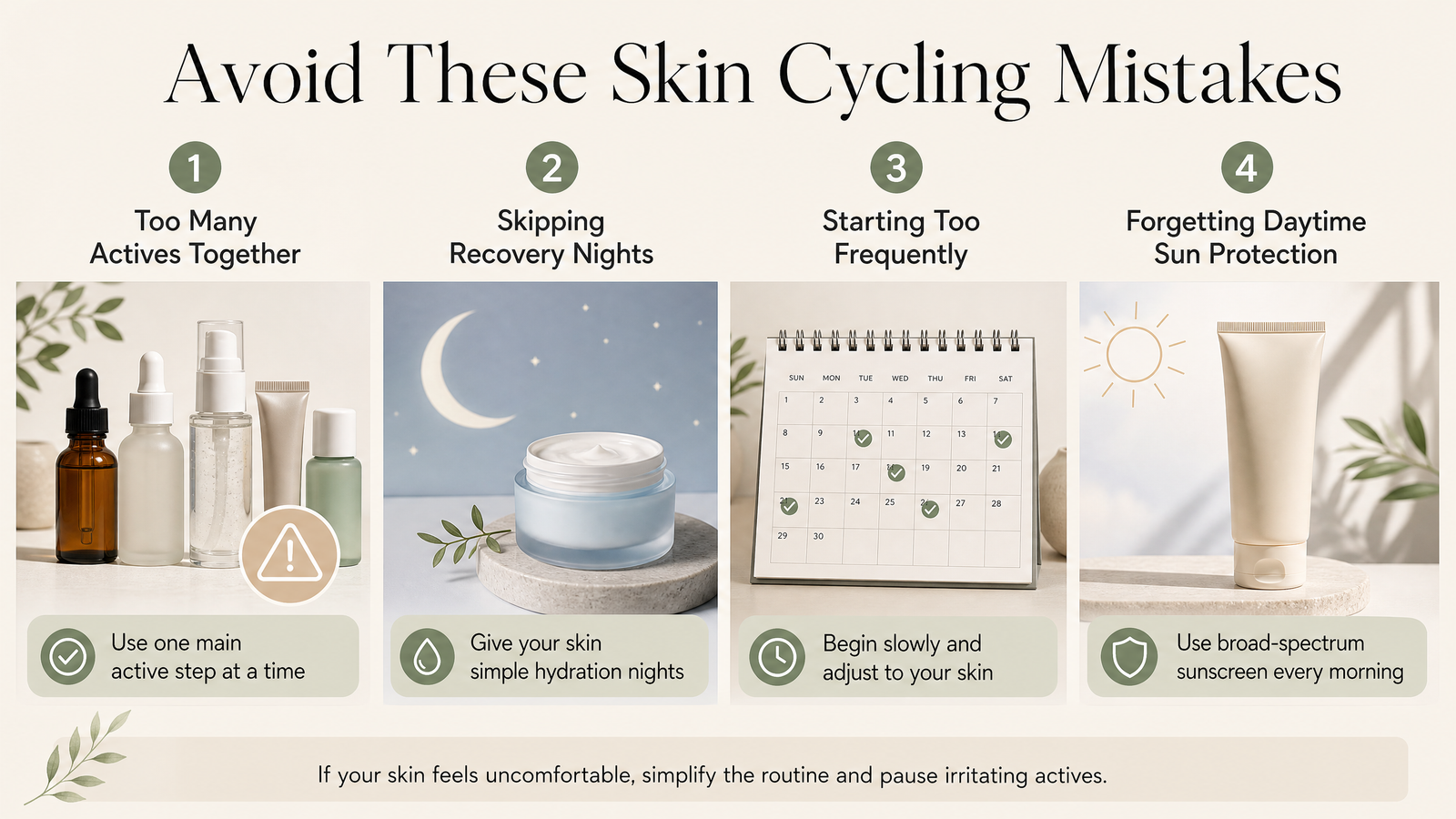
Common Skin-Cycling Mistakes to Avoid
Skin cycling is meant to make active ingredients easier to manage. It should not leave your skin constantly dry, red, or uncomfortable. These common mistakes can make the routine harder to tolerate.
Using Too Many Active Ingredients
Adding more products does not always lead to better results. Using an exfoliant, retinol, vitamin C, acne treatment, and other strong ingredients together can overwhelm your skin.
Start with one exfoliant and one retinoid. Give your skin time to adjust before adding anything else.
Combining Exfoliants with Retinol
Using an exfoliating acid on the same night as retinol can increase dryness, peeling, and irritation. This is why the classic routine places them on separate nights.
If your skin is sensitive or you develop dark marks easily after irritation, you may need even more space between active nights.
Exfoliating Too Often
Some people assume that daily exfoliation will make the skin smoother faster. In reality, over-exfoliation can weaken the skin barrier and make the skin feel tight, rough, or sensitive.
Do not exfoliate over sunburned, broken, or irritated skin. Reduce the frequency if your skin starts reacting.
Skipping Moisturizer
Oily or acne-prone skin still needs hydration. Skipping moisturizer can make the skin feel uncomfortable and may encourage you to use harsher products.
Choose a formula that suits your skin type. A lightweight, non-comedogenic lotion may work well for oily skin, while dry skin may need a richer cream.
Forgetting Sunscreen
Skin cycling happens at night, but daytime sun protection is just as important. UV exposure can worsen pigmentation and uneven skin tone.
Apply a broad-spectrum sunscreen with SPF 30 or higher every morning. Reapply after sweating, swimming, or spending a long time outdoors.
Changing Products Too Quickly
Skincare results take time. Changing products every few days makes it difficult to know what is helping and what is causing irritation.
Introduce one new active product at a time. Give your skin several weeks to adjust unless you experience a clear reaction.
Following the Same Schedule in Every Season
Your skin may need more recovery time during cold or dry weather. Heat, humidity, sweating, and frequent sun exposure can also change how your routine feels.
The four-night cycle is only a starting point. Add recovery nights whenever your skin feels dry, tight, itchy, or unusually sensitive.
Ignoring Warning Signs
Mild dryness may happen when you begin an active product, but persistent burning, swelling, painful peeling, raw patches, or spreading redness should not be ignored.
Stop the active products and return to gentle cleansing, moisturizer, and sunscreen. If your skin does not improve, speak with a dermatologist.
The most effective skin-cycling routine is not the strongest one. It is the routine your skin can tolerate and follow consistently.
How Long Does Skin Cycling Take to Show Results?
Skin cycling does not produce overnight results. Your skin may feel smoother after a few weeks, but changes in acne, texture, or pigmentation usually take longer.
Early Changes
During the first few weeks, focus on how your skin feels. It should not be constantly burning, peeling, or becoming more uncomfortable. If the routine suits you, your skin may gradually feel softer and less rough.
Some people may notice fewer clogged pores after using salicylic acid consistently. Retinol usually takes longer to show visible changes, especially when it is introduced slowly to prevent irritation.
Visible Results Take Time
Uneven texture and mild breakouts may improve over several weeks. Fine lines and pigmentation often need more time. The exact timeline depends on the cause of the concern, the products you use, how often you apply them, and whether you use sunscreen every morning.
Dark spots may take months to fade. Sun exposure, picking at acne, and repeated irritation can slow the process or make pigmentation darker. This is why a gentle routine and daily sunscreen matter so much.
Do Not Increase Actives Too Quickly
If you do not see quick results, do not immediately add more exfoliation or use a stronger retinoid. That approach can damage the skin barrier and may lead to more redness, dryness, or post-inflammatory pigmentation.
Give one routine enough time to work, unless it causes a clear reaction. Take photos in the same lighting every few weeks if you want to compare changes more accurately.
When to Reconsider the Routine
If your skin remains irritated after reducing active nights, stop the routine and return to gentle cleansing, moisturizer, and sunscreen. If there is no improvement after several weeks, or if your acne or pigmentation is getting worse, speak with a dermatologist.
Skin cycling is not a guaranteed treatment. It is a way to organize active ingredients and recovery time. Progress is usually easier to maintain when the routine is gentle enough to follow consistently.
Frequently Asked Questions About Skin Cycling
1. Can beginners try skin cycling?
Yes. Beginners can use skin cycling as a simple way to introduce exfoliants and retinol. Start with mild products and add extra recovery nights if your skin feels dry or irritated.
2. Can I follow skin cycling every week?
You can repeat the cycle if your skin tolerates it. However, the classic four-night pattern is not a rule. Some people may need more recovery nights between active treatments.
3. Can I use vitamin C during skin cycling?
Vitamin C is usually used in the morning, along with sunscreen. If your skin is sensitive, avoid adding it at the same time as several other active products. Introduce it separately and observe how your skin responds.
4. Can I use skin cycling if I have sensitive skin?
You may be able to, but start slowly. Use a gentle exfoliant, a low-strength retinol, and more recovery nights. If your skin burns, swells, or becomes persistently red, stop the active products and consult a dermatologist.
5. Can I use tretinoin in a skin-cycling routine?
Tretinoin is a prescription retinoid and can be stronger than over-the-counter retinol. Do not add it to a general routine without medical guidance. Follow the schedule given by your dermatologist.
6. Should I use moisturizer before or after retinol?
You can apply moisturizer after retinol. If retinol feels too drying, try the sandwich method: moisturizer first, then retinol, followed by another thin layer of moisturizer.
7. Can skin cycling help with acne and dark spots?
It may support a routine for mild acne, uneven texture, and some pigmentation concerns. Salicylic acid may suit oily or acne-prone skin, while retinol may support clearer-looking skin over time. Dark spots also require daily sunscreen and patience.
8. What should I do if my skin starts peeling?
Stop exfoliants and retinoids for the time being. Use a gentle cleanser, a bland moisturizer, and sunscreen. Do not peel or scrub the skin yourself. If the peeling is painful or does not improve, contact a dermatologist.
9. Can I use skin cycling during pregnancy?
Retinoids are generally avoided during pregnancy. If you are pregnant, trying to conceive, or breastfeeding, ask your healthcare professional which skincare ingredients are appropriate for you.
10. How long should I try skin cycling before judging the results?
Give the routine time, provided it is not irritating your skin. Texture and mild breakouts may take several weeks to improve, while pigmentation and fine lines can take longer. If your skin keeps getting worse, stop the routine and seek professional advice.
11. Is skin cycling suitable for everyone?
No. People with eczema, rosacea, psoriasis, active inflammation, severe acne, or a damaged skin barrier may need a different approach. It is safer to speak with a dermatologist before starting active ingredients in these situations.
12. What is the most important step in skin cycling?
There is no single magic step. A gentle cleanser, suitable moisturizer, careful use of active ingredients, and daily sunscreen all matter. The best routine is one your skin can tolerate and you can follow consistently.
Final Thoughts on Skin Cycling
Skin cycling is not about using more products or following a perfect schedule. It is about giving active ingredients their own place in your routine and allowing your skin enough time to recover.
The classic pattern starts with exfoliation, followed by retinol, and then two recovery nights. This can be a useful starting point, but it will not suit everyone in exactly the same way. Dry, sensitive, or easily irritated skin may need more recovery days. People with eczema, rosacea, psoriasis, severe acne, or prescription treatments should seek professional advice before starting.
Choose products carefully, introduce one active ingredient at a time, and never ignore signs such as persistent burning, swelling, painful peeling, or spreading redness. Moisturizer helps support your skin barrier, while daily broad-spectrum sunscreen helps protect your progress and prevent pigmentation from becoming more noticeable.
Most importantly, give your skin time. A gentle routine followed consistently is more useful than an aggressive routine that causes irritation.
Start with the basics tonight: cleanse gently, use only the product your skin is ready for, and finish with moisturizer. If you are new to skin cycling, begin slowly and adjust the routine whenever your skin asks for more recovery. Your goal is not perfect skin overnight—it is healthier, calmer skin over time.